 Gawah (The Witness) – Hyderabad India Fearless By Birth, Pristine by Choice – First National Urdu Weekly From South India – Latest News, Breaking News, Special Stories, Interviews, Islamic, World, India, National News

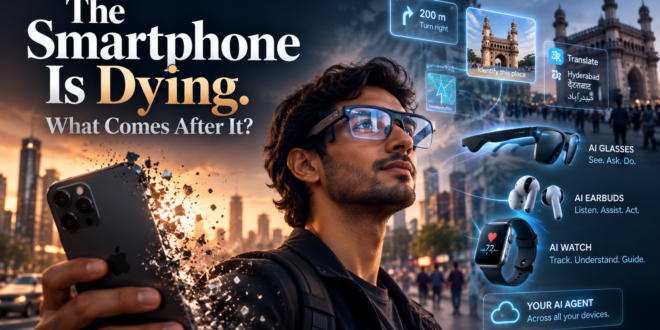
The device that put the internet in our pockets may not disappear anytime soon. But Apple, Google, Meta and Samsung are already working on what could come next.
For more than a decade, the smartphone has been the centre of our digital lives.
We wake up to it. We check it while having breakfast. We use it to navigate, pay bills, order food, take photographs, watch videos, read the news and talk to people thousands of kilometres away.
For all the talk about the next big smartphone, however, some of the most interesting work in consumer technology is happening outside the phone.
Meta is putting AI into glasses. Google is developing Gemini-powered eyewear. Samsung is building its Android XR platform. AI companies are working on agents that can perform tasks rather than simply answer questions.
None of this means the smartphone is about to vanish.
It does suggest something more interesting: the phone may gradually stop being the main way we interact with the technology around us.
The phone will probably stay. Our dependence on its screen may not.
There is a practical reason smartphones are difficult to replace.
They have large displays, powerful processors, cameras, cellular connectivity, batteries and access to millions of apps. A pair of glasses cannot realistically offer the same experience.
But not every interaction needs a six-inch screen. Checking the weather doesn’t. Asking for directions doesn’t. Translating a sign doesn’t. Sending a short message doesn’t. Finding out who is calling doesn’t.
These are the small tasks that make up a surprising amount of our daily phone use. They are also exactly the sort of things that newer AI-powered devices are being designed to handle.
That is where the post-smartphone conversation gets interesting.
Why everyone is looking at glasses
Smart glasses have been around for years, but earlier attempts often looked like technology searching for a reason to exist.
AI changes that equation. Meta’s latest smart glasses combine cameras, microphones and speakers with access to its AI assistant. The company is also expanding its hardware range and developing Muse, a more capable AI system intended to act as a personal assistant.
Google is taking a similar route. Its Android XR platform is designed to bring Gemini into headsets and glasses, allowing users to ask questions, get directions, translate text and interact with digital information without constantly reaching for a phone.
Samsung is also working on intelligent eyewear as part of its Android XR push.
The significance isn’t that glasses are replacing smartphones. They aren’t. The significance is that companies are trying to make the interface disappear. You don’t have to stop what you’re doing, take your phone out of your pocket, unlock it and find an app. You simply ask.
AI could be more important than the hardware
The biggest change may not come from glasses at all. It could come from AI agents.
For years, using a smartphone meant learning where everything was. Need a cab? Open an app. Want dinner? Open another. Need a hotel? Search another service.
AI agents turn that model around. Instead of telling a computer which application to use, you tell it what you want. “Find me a restaurant nearby.”
“Book a table for two.” “Check my flight.” “Send this message.” “Find the cheapest option and buy it.”
The technology isn’t ready to handle every one of those tasks perfectly, and giving an AI permission to make purchases or send messages raises obvious questions about security and control.
But the direction is clear.
Google and other technology companies are increasingly building systems that can work across applications rather than simply producing an answer inside a chatbot.
That could eventually make the app itself less important.
What happens to the app economy?
The smartphone created the app economy.
There is an app for almost everything now — banking, shopping, travel, food delivery, transport, entertainment and communication.
AI agents could change the front end of that system. The services themselves may remain. What changes is how people reach them. Instead of opening five different apps to plan a trip, for example, a user could eventually tell an AI assistant what they want and let it deal with the individual services.
The apps don’t necessarily disappear. They become infrastructure. That would be a major change in the way the internet works. It would also change which companies control the relationship with the user. Today, the relationship often belongs to the app. In an agent-driven internet, it could increasingly belong to the AI platform sitting between the user and those services. That is one reason the competition around AI assistants matters so much.
The privacy problem is harder to solve
There is another side to all this. A smartphone already knows a great deal about its owner. AI glasses could know more. They can potentially see what you are looking at, hear conversations and understand where you are. Add an AI assistant that can remember context and access other services, and the amount of personal information involved becomes considerably larger. That raises questions that the technology industry has not fully answered.
What happens when a camera is pointed at someone who hasn’t agreed to be recorded?
How long is the information stored? Who can access it? What does an AI remember? And what happens when an AI agent is allowed to act on someone’s behalf? These aren’t theoretical questions. Privacy concerns are already emerging around AI-powered glasses and other devices designed to operate continuously around their users.
For the post-smartphone era to work, convenience won’t be enough. People will have to trust the devices.
Your next computer may be several devices
This is perhaps the most likely outcome.
The successor to the smartphone may not be another single product. Your glasses could handle quick visual information and conversations. Earbuds could provide audio. A watch could handle health data and notifications. An AI assistant could sit across all of them.
And the smartphone could remain in your pocket, quietly providing connectivity, processing power, identity and access to the services underneath. That would make the phone less visible without making it irrelevant. The change would be similar to what happened with the personal computer. We didn’t stop using computers when smartphones arrived. We simply stopped needing a traditional computer for every task. The same thing could happen again.
So, is the smartphone dying?
Not in the conventional sense. There is little reason to think people will stop buying smartphones in the near future. The hardware remains too useful and too deeply embedded in everyday life.
But the smartphone as the primary interface to the digital world could be approaching a transition. The first phase of mobile computing was about putting the internet in our hands. The next phase may be about removing the need to look at a screen for every interaction. That is why Apple, Google, Meta and Samsung are investing in AI, glasses, wearables and new forms of computing.
They aren’t necessarily trying to kill the smartphone. They are trying to make it less necessary. And if they succeed, the biggest change may be surprisingly easy to miss. One day, you may realise you’ve gone through an entire afternoon without taking your phone out of your pocket.
That could be what the post-smartphone era actually looks like.