 Gawah (The Witness) – Hyderabad India Fearless By Birth, Pristine by Choice – First National Urdu Weekly From South India – Latest News, Breaking News, Special Stories, Interviews, Islamic, World, India, National News

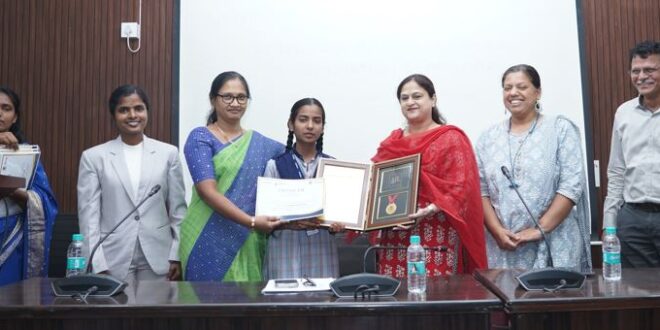
Hyderabad, March 24: At the Telangana Minorities Residential Educational Institutions Society (TGMREIS) headquarters in Nampally on Tuesday, the discussion on artificial intelligence focused more on abstractions than algorithms. It centered on choices, anxieties, small acts of care, and how technology might respond to them.
On Tuesday, students from approximately 40 TGMREIS schools presented a series of AI-powered applications at the end of Phase One of a statewide literacy program that trained over 2,000 students across seven districts. Many of these projects were driven less by technical goals and more by personal observations.
Ameena, a ninth-grade student, created a course explorer after seeing her classmates struggle to decide what to study next. Her app recommends courses and colleges based on grades and interests, providing, as she explained, a clearer path for students unsure of their options.
Saleema from Bahadurpura Girls School took a different approach. Her project traces her own journey through TGMREIS in the format of web stories, part documentation, part reflection, but in essence, capturing moments that might otherwise go unrecorded. For Salma, also in Class IX, the starting point was closer to home. Her platform, ParentConnect, attempts to bridge the gap between children and parents, shaped by her own experiences and the idealized relationships she encountered in cartoon movies and television dramas. Several students turned to questions of sustainability and welfare. Manasvi worked on a model for producing eco-friendly manure from kitchen waste and fallen leaves, while another student created a platform focused on the well-being of orphaned children.
Fatima from Yakutpura created Warm Hearts, a website aimed at organizing the donation of unused clothes. “Someone’s used clothes could help someone else in need,” she said. Suhasree from Mahabubnagar developed GiveLife, a platform designed to connect donors for blood, financial aid, and organs during emergencies. Sana from Jadcherla introduced GoGreen, which promotes organic farming and healthier living practices.
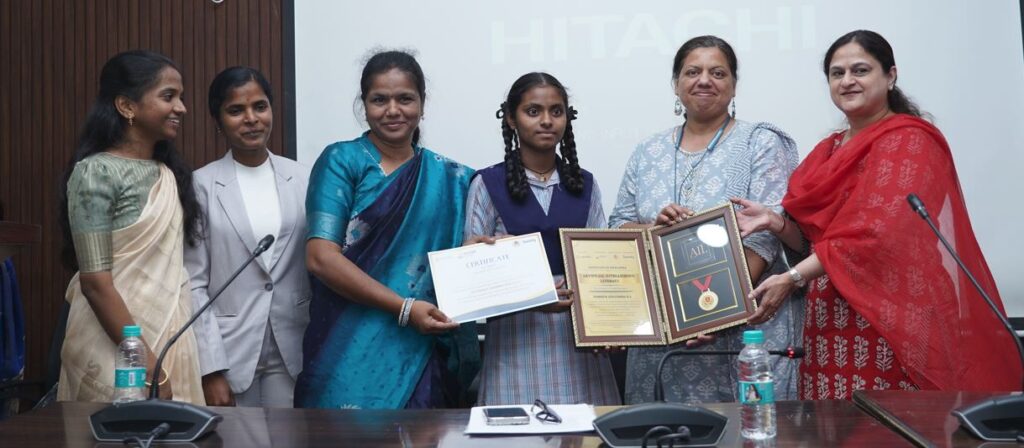
The projects were part of what organizers described as India’s first AI literacy programme in government schools, conducted across seven districts in collaboration with United Welfare Hyderabad, Centific, and Swinfy. The first phase of the programme was held in February.
Aditi Khandekar, Strategy and Impact Head at United Welfare Hyderabad, said the initiative was piloted in Telangana as part of the organization’s focus on education and upskilling, under the leadership of its CEO, Rekha. The program was structured as a series of four-day workshops, with three-hour sessions starting with basic computer literacy and gradually introducing students to research framing, problem identification, critical thinking, and practical AI tools. She noted that students quickly progressed from initial unfamiliarity to building working applications and praised their enthusiasm and creativity.
Rani G., CEO of Swinfy Solutions and the training partner for the program, said artificial intelligence would soon become as common as electricity. She mentioned that the training focused not only on using AI tools to generate text, images, and audio but also on understanding how to interact with these systems responsibly. The goal, she added, was to give students a broad understanding of both the possibilities and the limitations of AI.
For many students, this was their first extensive exposure to digital tools. However, the output displayed included functional websites, structured applications, and, in some cases, interactive features, indicating a quick shift from unfamiliarity to experimentation.
In a message, Minority Welfare Minister Mohammad Azharuddin praised the students for showcasing their “AI creativity with a heart and soul,” urging them to use technology responsibly and for broader social good.
TGMREIS Vice Chairman Mr Faheem Qureshi lauded the students and termed the achievement a ‘big leap towards sensible education and application of AI’.
Dr. B. Shafiullah, Secretary of TGMREIS, stated that the initiative aimed to equip students with relevant skills and encourage them to solve everyday problems using technology. Academic consultants Sadia Alladin and Srinivas Rao described the program as a turning point for many participants, noting a noticeable boost in confidence. The event wrapped up with the distribution of certificates and a song created by students using AI tools – a closing note that, like many projects on display, was built with AI but carried a distinctly human touch.