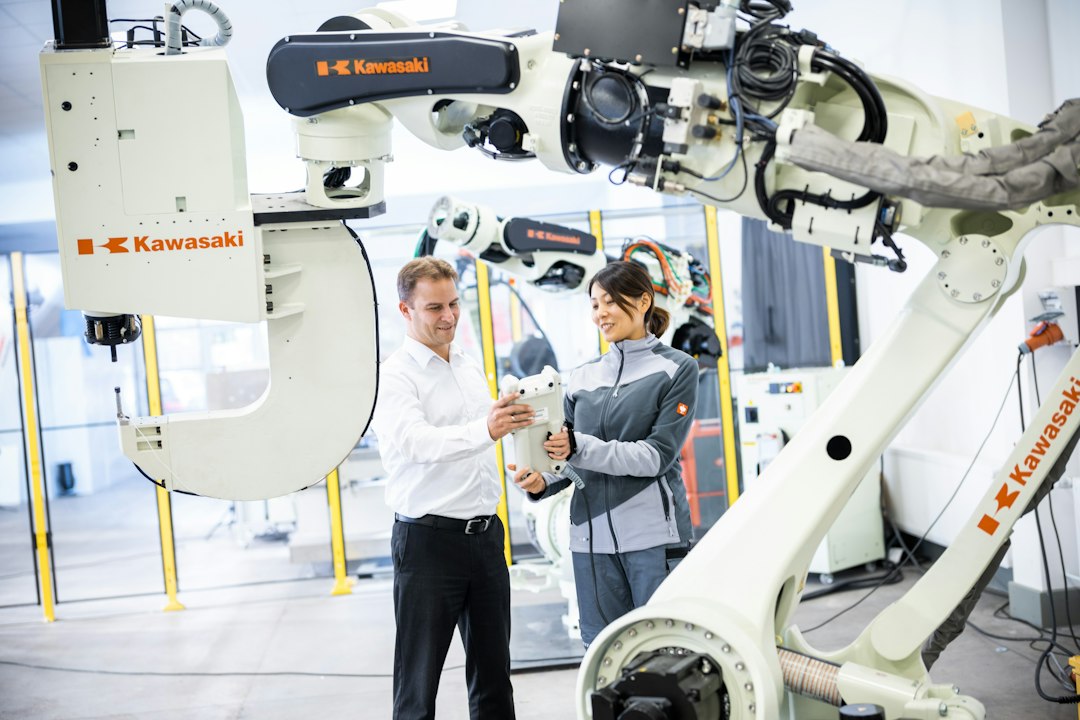
From factory floors and warehouses to hospitals, hotels and eventually homes, robots are moving beyond specialist machinery. The next big shift is not a robot takeover overnight, but machines taking on more practical tasks—and changing how people work.
GAWAH Technology Desk
Imagine arriving at work and finding a robot moving supplies through the building, inspecting equipment, sorting packages or helping a technician complete a routine task. In some workplaces, this is already normal. The bigger question is how soon robots will move into more jobs—and what that will mean for workers in India.
The transition is under way, but it is not happening at the same speed everywhere. Industrial robots are already established in manufacturing. Service robots are expanding in logistics, healthcare and commercial facilities. Humanoid robots designed to work in spaces built for people are attracting investment and attention, but their ability to perform varied tasks reliably outside controlled settings remains a work in progress.
Robots are already at work—just not always in human form
Robotics is much broader than a machine with a head, two arms and two legs. Many of the robots changing workplaces today are robotic arms, autonomous mobile machines, inspection systems or specialised devices designed to perform one task consistently.
The International Federation of Robotics reported that approximately 542,000 industrial robots were installed worldwide in 2024, more than double the number installed a decade earlier. The total number of industrial robots operating in factories reached about 4.66 million that year. Asia accounted for 74% of new installations.
India is part of this expansion. The same report recorded a national high of 9,100 industrial robot installations in 2024, up 7% from the previous year. The automotive industry was the biggest driver, accounting for 45% of installations.
These figures describe industrial robots, not humanoid robots or every type of service robot. They nevertheless show that automation is already a practical part of the global economy—not merely a prediction about the distant future.
Where could robots become your co-workers first?
1. Factories and warehouses
Repetitive lifting, moving goods, packaging, inspection and some assembly operations are natural early applications. Machines can work in predictable environments, repeat the same movements and take on tasks that are physically demanding or potentially hazardous.
In warehouses, autonomous mobile robots can transport shelves, bins or packages. In factories, robotic arms can weld, paint, handle components or perform quality checks. People are still needed to plan workflows, maintain equipment, resolve unusual situations and supervise operations.
2. Hospitals and care facilities
Hospitals can use robots to move supplies, deliver meals, transport samples and support cleaning. These tasks can free staff to spend more time on patients. More complex physical assistance and direct care remain harder because safety, dexterity, trust and human judgement matter.
3. Hotels, shops and commercial buildings
Cleaning machines, inventory scanners, delivery robots and automated food-preparation systems can already handle selected jobs. Wider adoption depends on whether they work reliably around people, fit into existing buildings and cost less than the combination of labour and other operating expenses they replace.
4. Homes and everyday life
Robot vacuum cleaners and lawn-mowing robots are already consumer products. A general-purpose home robot that can reliably tidy a cluttered room, fold different kinds of laundry, prepare a meal and put objects away is a much harder challenge.
Homes are unpredictable: objects move, floors vary, pets get in the way and instructions can be ambiguous. A demonstration of one successful task does not prove a robot can perform that task safely and consistently in thousands of ordinary homes.
When will robots become common?
There is no single date when robots will become part of everyday life. The likely pattern is gradual adoption, with different sectors moving at different speeds.
- Now and the next few years: More specialised robots in factories, warehouses, hospitals and large commercial facilities, where tasks and environments can be tightly controlled.
- Later this decade: Potentially more trials and limited deployments of general-purpose and humanoid robots in selected workplaces. Their expansion will depend on safety, reliability, maintenance needs and the cost per completed task.
- The 2030s and beyond: Broader household and small-business use is possible if robots become affordable, dependable and easy to operate. The timing and scale remain uncertain.
These are broad scenarios, not firm forecasts. Companies may announce ambitious deployment targets, but a pilot project or product demonstration is not the same as widespread commercial adoption.
Will a robot take your job?
Robots are more likely to automate tasks before they replace entire occupations. A warehouse worker may spend less time moving goods and more time handling exceptions. A technician may use robots to inspect dangerous equipment. A hospital worker may delegate deliveries while retaining responsibility for patient care.
Some roles will face pressure, particularly where work is repetitive, physically predictable and easy to measure. Other jobs may change rather than disappear, while demand could grow for people who install, repair, programme, supervise and integrate robotic systems.
The World Economic Forum’s Future of Jobs Report 2025 identifies robotics and autonomous systems among the major forces expected to reshape employment through 2030. Its projections point to disruption, not a guaranteed outcome for any individual worker or profession.
The effect will depend on more than technical capability. Businesses will weigh the purchase price, maintenance, downtime, safety requirements, training, productivity and whether customers want the resulting service. Regulation and the availability of skilled workers will also influence adoption.
What this means for India
India’s record industrial robot installations show that automation is growing, especially in manufacturing. But the country is not moving uniformly: a large factory with repeatable production lines has very different needs from a small shop, construction site, farm or family home.
For Indian businesses, the opportunity is not limited to buying imported robots. It includes building and maintaining machines, developing control software, integrating sensors and AI, securing automated systems, and training people to work safely alongside them.
For workers and students, practical skills in robotics, electronics, maintenance, automation, data, safety and problem-solving can become valuable. Even people who never build a robot may need to learn how automated systems fit into their industry.
What will decide how quickly robots arrive?
Five factors will matter most: price, reliability, safety, flexibility and the cost of maintaining a robot over its working life. A machine that performs impressively in a video may still struggle with unpredictable environments, battery life, repairs or the many small variations that occur during a normal shift.
Humanoid designs have one potential advantage: human environments are built around human-sized spaces, tools and workstations. But two legs and two arms are not automatically the most efficient solution for every job. A wheeled robot or a fixed robotic arm may be cheaper, faster and safer for a specific task.
That is why the near future may contain a mixture of specialised machines, mobile robots, AI-powered software and some humanoid systems—not a single robot design replacing every kind of worker.
The bottom line
Your next co-worker could indeed be a robot. In many factories and warehouses, that co-worker is already there, even if it looks more like a robotic arm or a mobile platform than a human being.
The next stage will be more visible as robots take on a wider range of physical tasks. But a future in which every home, shop and office has a general-purpose humanoid remains uncertain. The most useful question is not simply when robots will arrive. It is which tasks they can do safely and economically, how people will adapt, and who will benefit from the change.