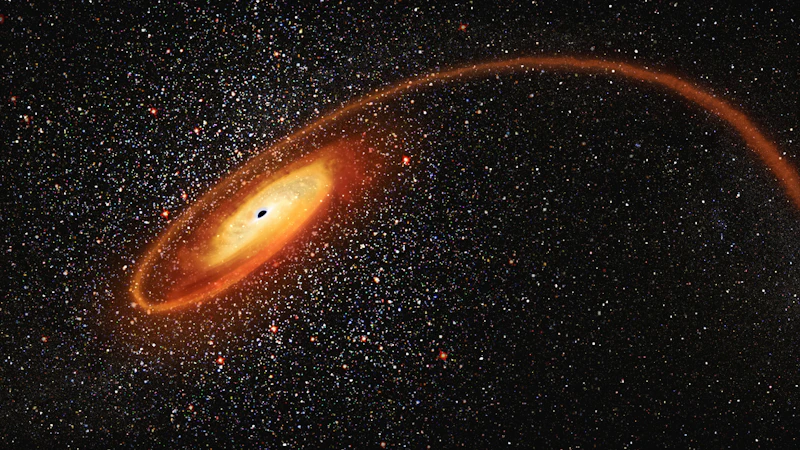
Imagine drifting through space and spotting a black hole ahead. It may look like a dark patch surrounded by a glowing ring, but what would happen if you fell toward it—and crossed the point from which not even light can escape?
The short answer is that the journey would be dangerous beyond anything humans can experience on Earth. The details, however, depend on the black hole’s size and on how close you get. Scientists understand a great deal about black holes, but what happens deep inside one remains an open question.
First, what exactly is a black hole?
A black hole is a region of space where gravity is so strong that nothing—not even light—can escape once it crosses a boundary called the event horizon. Some black holes form when massive stars reach the end of their lives and collapse. Others, including supermassive black holes, can contain millions or billions of times the mass of our Sun.
Despite the name, a black hole is not a cosmic vacuum cleaner that automatically sucks in everything around it. From far away, its gravity behaves like the gravity of any other object with the same mass. Matter must come close enough to be captured.
Scientists usually cannot see a black hole directly because light cannot escape from inside its event horizon. Instead, telescopes study its effects on nearby stars and gas, and the light emitted by superheated material swirling around it. NASA explains how astronomers detect and study black holes.
What would happen as you approached one?
If you travelled toward a black hole, the view around you would become increasingly strange. Its gravity can bend the path of light, making the background sky appear distorted. Many black holes are surrounded by an accretion disk—gas and dust heated to extremely high temperatures as it spirals inward. That glowing material, rather than the black hole itself, can be visible.
There would be another danger: radiation from hot material around some black holes. Getting close to an active black hole could be lethal long before you reached its event horizon.
Would you be stretched like spaghetti?
Possibly—and the scientific term is spaghettification. Gravity becomes stronger the closer you are to an object. If the difference in gravity between your feet and your head became extreme, your body would be stretched in one direction and squeezed in another.
How soon this happens depends on the black hole. Around a smaller black hole, tidal forces near the event horizon can be enormous. A supermassive black hole has a much larger event horizon, so the difference in gravity across a person at that boundary can be smaller. That does not make a trip inside safe: once you cross the event horizon, there is no route back out.
NASA’s Space Place guide to black holes introduces the event horizon and explains how intense differences in gravity can stretch objects.
Would time slow down?
Gravity affects time. To a distant observer watching from far away, signals from someone approaching the event horizon would become increasingly delayed and dim. The falling traveller’s own clock, however, would feel normal to them locally. What each observer sees is different because they are in different gravitational conditions and receive light signals differently.
This is one reason black holes are important to physicists: they provide extreme environments for testing ideas about gravity, space and time.
What happens after you cross the event horizon?
The event horizon is a point of no return. Once inside it, every possible future path leads deeper inward; escaping would require travelling faster than light, which our current understanding of physics does not allow. You could not send a message back to someone outside with news of what you found.
Scientists use Einstein’s theory of general relativity to describe many aspects of black holes. But the deepest interior—and what ultimately happens at the centre—cannot yet be fully explained because our current theories are incomplete under those extreme conditions. No human has ever fallen into a black hole, and we cannot directly observe the interior.
Could a black hole swallow Earth?
There is no known black hole close enough to pose that threat to Earth. Black holes do not roam through space like giant vacuum cleaners, and our planet is not in danger of suddenly being pulled into one. The Sun will not turn into a black hole either: it does not have enough mass to end its life that way.
Quick answers: black holes explained
Can anything escape a black hole?
Nothing can escape from inside the event horizon—not even light. Material outside the boundary can still orbit the black hole or escape, depending on its path and energy.
Would you notice the exact moment you crossed the event horizon?
For a sufficiently large black hole, crossing the event horizon might not feel like hitting a physical surface. The danger comes from what the black hole’s gravity and the journey inward would do, and there would be no way back out.
Do scientists know what is inside a black hole?
Not completely. Scientists can test theories against observations outside black holes, but the interior cannot send information back across the event horizon. The deepest questions remain part of active research.
The big takeaway
Falling into a black hole would mean crossing a one-way boundary into a place where gravity reshapes space and time. Tidal forces could stretch you, and the physics of the deepest interior remains uncertain. The most important lesson is also the simplest: black holes are extraordinary objects, but scientists separate what observations support from what remains unknown.