Could humans stop an asteroid from hitting Earth? Scientists have now tested one possible answer: send a spacecraft crashing into it and measure whether its path changes. NASA’s DART mission did exactly that in 2022—and later analysis found that the impact changed not only the motion of the target asteroid’s small moon, but also the orbit of the two-asteroid system around the Sun.
That is a major milestone for planetary defence. But it is not a magic shield against every space rock. Scientists still need to understand how different asteroids respond, how much warning time would be needed and how to choose the right response for a real threat.
What did NASA’s DART mission do?
DART stands for Double Asteroid Redirection Test. On 26 September 2022, NASA deliberately crashed the spacecraft into Dimorphos, a small asteroid moonlet orbiting the larger asteroid Didymos. The pair was selected for the experiment because it was not a threat to Earth.
The impact shortened Dimorphos’s orbit around Didymos by about 33 minutes. That was much more than the mission’s minimum success criterion. It was the first full-scale demonstration that a spacecraft could intentionally change the motion of a celestial object by hitting it.
NASA’s DART mission overview explains how the spacecraft navigated to its target and how astronomers measured the change after impact.
How can a collision move an asteroid?
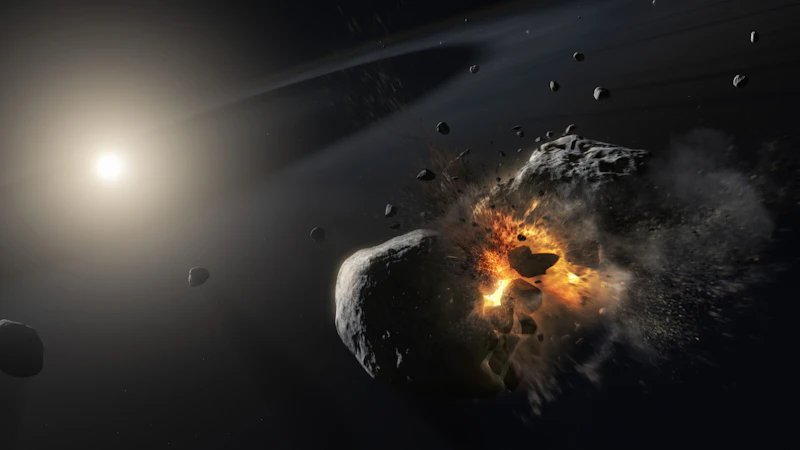
The idea is called the kinetic impactor technique. A spacecraft travelling at high speed transfers momentum to an asteroid when it collides with it. The impact also throws rocky material into space. That escaping debris can provide an additional push, a little like recoil, changing the asteroid’s motion.
The result depends on several factors: the spacecraft’s mass and speed, the asteroid’s mass, its internal structure and how much debris the collision ejects. A loosely packed “rubble pile” may respond differently from a more solid object. That is why one successful test is an important beginning, not the end of the research.
The surprising finding: the pair’s orbit around the Sun changed too
In March 2026, NASA reported new research showing that DART’s impact also changed the orbit of the Didymos–Dimorphos system around the Sun. Measurements indicated that the pair’s roughly 770-day solar orbit shifted by a fraction of a second.
That is a tiny change, but it is scientifically significant: it is the first measured instance of a human-made object altering a celestial body’s path around the Sun. Over a long enough period, a small change in motion can lead to a larger difference in where an object travels. The practical outcome for any future threat would depend on its orbit, size and how early it was detected.
Read the NASA report on DART’s effect on the asteroid pair’s solar orbit.
What is ESA’s Hera mission going to investigate?
NASA’s impact showed that asteroid deflection can work. The European Space Agency’s Hera mission is designed to examine the aftermath in much greater detail. Launched in October 2024, Hera is travelling to the Didymos system to study Dimorphos, measure the asteroid pair and investigate the impact site.
In an update published on 7 October 2026, ESA said Hera had begun preparing for sustained braking manoeuvres as it approaches its destination. The spacecraft is expected to rendezvous with the asteroid system in November 2026. Its measurements should help researchers better understand Dimorphos’s mass, structure and the crater left by DART.
Those details matter because planetary defence needs predictions that can be trusted. If scientists know how an asteroid is built and how efficiently it responds to an impact, they can improve models for future missions. Follow the latest details on ESA’s official Hera mission page.
Could we use this to save Earth?
Potentially, if a hazardous asteroid were discovered early enough and a suitable mission could be launched. The basic strategy would be to change its speed or orbit slightly, so that years later it would miss Earth rather than collide with it. A small nudge applied well in advance can be more useful than trying to move an object at the last minute.
However, the method is not guaranteed to work for every object. An asteroid could be too large, discovered too late, or made of material that responds differently from Dimorphos. Scientists would also need accurate observations of its orbit and enough time to plan, launch and guide a spacecraft.
Neither Didymos nor Dimorphos posed an impact threat to Earth before or after the DART experiment. The mission was a controlled test of a possible future defence method, not a response to an asteroid on a collision course with our planet.
Quick answers: asteroid deflection
Did DART destroy the asteroid?
No. DART hit Dimorphos to change its motion. The goal was to alter its orbit, not blow it apart.
Can scientists now deflect any asteroid?
No. DART proved one technique can work on one particular asteroid system. More observations and modelling are needed to know how well it would work on different objects.
Why is Hera important if DART already succeeded?
DART measured a change in the orbit, but scientists need close-up information about the asteroid’s mass, structure and impact crater to understand exactly why the technique worked and how to predict its effect elsewhere.
The takeaway
Humans have demonstrated that we can change the motion of an asteroid with a spacecraft impact. DART was a landmark proof of concept, and Hera’s close-up investigation is intended to make the method better understood. Planetary defence is not about panicking over every asteroid; it is about finding potentially hazardous objects early, measuring their paths carefully and developing tested ways to reduce risk.