 Gawah (The Witness) – Hyderabad India Fearless By Birth, Pristine by Choice – First National Urdu Weekly From South India – Latest News, Breaking News, Special Stories, Interviews, Islamic, World, India, National News

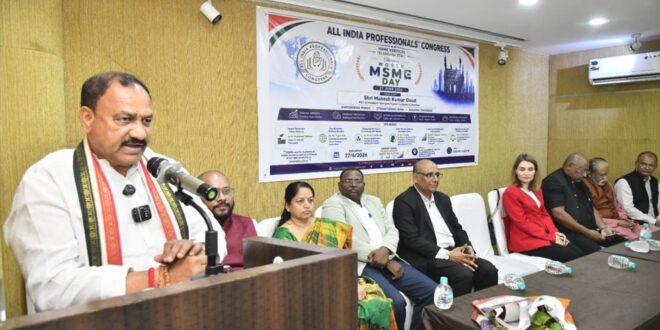
World MSME Day discussion in Hyderabad highlights the need for inclusive growth, innovation, sustainability and women-led enterprise.
When conversations about India’s economy dominate the headlines, they are usually centred on billion-dollar startups, global corporations and soaring stock markets. Yet, beneath these headline-grabbing stories lies another economy that quietly powers the nation. It employs millions, supports families, fuels local innovation and sustains communities across urban and rural India.
That economy belongs to India’s Micro, Small and Medium Enterprises, popularly known as MSMEs.
This broader vision of entrepreneurship took centre stage at the World MSME Day celebrations organised by the All India Professionals’ Congress (AIPC) Telangana MSME Vertical at the Media Plus Auditorium in Hyderabad. The gathering brought together political leaders, diplomats, development experts, entrepreneurs and industry representatives around a shared belief that India’s journey towards becoming a developed nation will ultimately be shaped by its smallest businesses.
The Real Engine of India’s Economy
Delivering the keynote address, Telangana Pradesh Congress Committee President and MLC Mahesh Kumar Goud described MSMEs as the backbone of India’s economy.
He argued that while large corporations often dominate public attention, it is small enterprises that generate widespread employment and create opportunities at the grassroots. Across Asia, MSMEs contribute more than 60 percent of employment and nearly half of the global GDP, making them indispensable to sustainable economic development.
Mahesh Kumar Goud noted that Telangana’s economy itself is largely driven by small businesses employing three to five people. Encouraging more such enterprises, he said, would not only generate employment but also reduce the growing concentration of wealth in the hands of a limited section of society.
He observed that Congress had recognised the importance of MSMEs as part of its economic vision, giving the sector greater policy emphasis since 2019. Referring to Rahul Gandhi’s Bharat Jodo Yatra, he said the exercise helped the party better understand the aspirations and challenges faced by ordinary citizens.
He also praised the caste survey undertaken by the Telangana Government under Chief Minister Revanth Reddy, describing it as the first comprehensive exercise since the 1931 British census. The survey, he said, would help governments identify economically weaker sections across communities and frame more targeted welfare policies.
Highlighting the Congress party’s long-standing commitment to women’s leadership, Mahesh Kumar Goud recalled leaders such as Indira Gandhi, Sonia Gandhi and Priyanka Gandhi, while noting that Indian women today excel in professions ranging from aviation and engineering to public administration. India, he pointed out, has already had both a woman Prime Minister and a woman President.
He also referred to several welfare initiatives of the Telangana Government, including free electricity up to 200 units, supply of quality rice, farm loan waivers and the issuance of ration cards, stating that the government remains committed to expanding opportunities for MSMEs.
Investing in Young People
The discussion soon moved beyond economics to focus on the country’s greatest resource, its youth.
UNICEF Telangana Chief Dr. Zeelalman Taffesse urged governments to invest in young people and nurture a new generation of innovative entrepreneurs capable of building smarter and more sustainable enterprises.
His remarks reflected a growing global consensus that development cannot be measured merely by economic growth. It must also be measured by how effectively societies empower young people to create solutions, generate employment and contribute to nation-building.
Women Entrepreneurs Need Equal Opportunities
Another important dimension of the discussion centred on women-led enterprises.
Speaking on the theme “When Women Venture, Economies Grow,” T. Sujatha, Senior Director and Deputy CEO of the Federation of Telangana Chambers of Commerce and Industry (FTCCI), highlighted an important contradiction.
Women reinvest nearly 90 percent of their earnings into their families, improving education, healthcare and overall quality of life. Yet women-led startups continue to receive barely two percent of global venture capital funding.
In a city like Hyderabad, which has emerged as one of India’s leading startup ecosystems with institutions such as T-Hub and several incubation centres, she argued that the challenge is no longer generating ideas but ensuring that deserving entrepreneurs receive adequate financial support.
Closing the funding gap for women entrepreneurs, she said, is both an economic necessity and a social imperative.
Sustainability Can Create the Next Wave of Businesses
One of the most thought-provoking perspectives came from Tugce Gul, Commercial Attaché at the Consulate General of Türkiye in Hyderabad.
Referring to the growing economic partnership between India and Türkiye, she noted that bilateral trade has reached nearly US$7.5 billion, covering petroleum products, marble, chemicals, agricultural produce and Turkish hazelnuts. Nearly 14 Turkish companies are currently operating in India, creating opportunities for greater industrial collaboration.
Environmentalist B.V. Subba Rao shifted the discussion towards sustainability. He suggested that restoration of urban lakes alone could generate nearly one million jobs by converting invasive water hyacinth into fibre, textiles, handicrafts and furniture.
His message was simple. Environmental challenges can also become economic opportunities when innovation meets entrepreneurship.
Beyond Numbers
Several speakers agreed that India’s future will depend not merely on financial incentives but on creating an entrepreneurial culture rooted in innovation, sustainability and inclusion.
Former AIPC Chapter President Irfan Aziz argued that MSMEs would shape India’s future by solving local problems with globally relevant solutions. Describing the sector as the country’s most powerful engine for economic growth and employment generation, he noted that India has more than 63 million MSMEs, contributing nearly 30 percent of the country’s GDP, accounting for approximately 45 percent of exports, and providing employment to over 110 million people.
Those figures, he said, underline why strengthening MSMEs is essential to India’s long-term economic aspirations.
P. Srinivas, Chairman of the Confederation of MSMEs Telangana, echoed this sentiment. He said MSMEs possess enormous potential to create employment across both rural and urban India and welcomed government incentives aimed at encouraging greater participation by women entrepreneurs.
Building an Ecosystem for Enterprise
Looking beyond conventional industries, Shashank Pasupuleti, State Head of the AIPC Telangana MSME Vertical, urged entrepreneurs to think differently about sustainability.
He described agricultural waste as an untapped economic resource and observed that even cow dung could become “Green Gold” through the production of organic fertilisers, bio-fertilisers, vermicompost, bio-energy and several other environmentally sustainable products.
He said the AIPC MSME Vertical intends to function as a bridge between entrepreneurs and government institutions by helping MSMEs access welfare schemes, financial support and business opportunities across Telangana.
Abdullah Bakran, Deputy State Head of the AIPC Telangana MSME Vertical, said the objective of the conference was to create a collaborative platform where entrepreneurs, policymakers, industry leaders, financial institutions and subject experts could jointly examine challenges and recommend practical solutions for strengthening the MSME ecosystem.
He expressed confidence that the ideas emerging from the conference would help shape future action plans, encourage innovation and strengthen cooperation among all stakeholders working towards sustainable economic growth.
A Shared Vision for the Future
The programme reflected an emerging consensus that India’s aspiration to become a developed nation cannot rest solely on the success of large corporations.
It will depend equally on whether young graduates become entrepreneurs instead of job seekers, whether women gain equal access to finance, whether sustainability becomes a driver of enterprise, and whether governments continue creating ecosystems where small businesses can flourish.
The event brought together a diverse group of leaders including Mahesh Kumar Goud, Dr. Zeelalman Taffesse, Tugce Gul, B.V. Subba Rao, T. Sujatha, P. Srinivas, Irfan Aziz, Shashank Pasupuleti and Abdullah Bakran. Also present were Dr. Gellila Aditya Reddy, AIPC Telangana State President, Sujana Reddy, State Head of the Architectural Vertical, Maria Tabassum, Deputy Lead of the Academia Vertical, Bhanu Murthy, Hyderabad District Head of the MSME Vertical, Sai Reddy of the Indian Youth Congress, along with entrepreneurs, professionals and representatives from industry and academia.
World MSME Day in Hyderabad was therefore more than an annual observance. It served as a reminder that India’s next economic transformation is likely to begin not inside the boardrooms of its largest companies, but in small workshops, family enterprises, innovative startups and community businesses that collectively form the foundation of the nation’s economy.