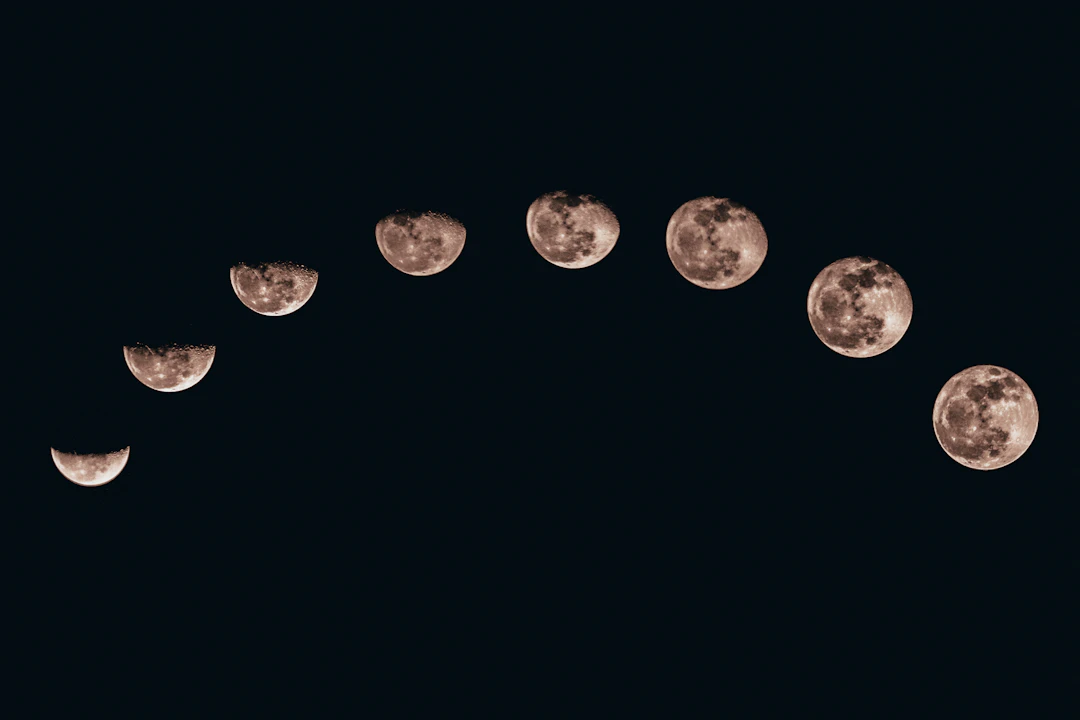
Quick answer: The Moon does not physically change shape. As it travels around Earth, we see different amounts of its sunlit half. Those changing views are called the Moon’s phases.
Why does the Moon look different every night?
The Moon does not make its own light. Sunlight illuminates one half of it, while the other half is in darkness. As the Moon moves along its orbit, the angle between the Sun, Moon and Earth changes. From Earth, we see different portions of the bright half—and the Moon appears to change shape.
NASA explains that this cycle takes about 29.5 days from one new moon to the next. The Moon itself remains roughly spherical throughout the cycle.
The eight phases of the Moon
- New Moon: The side facing Earth is mostly dark, so the Moon is difficult to see.
- Waxing Crescent: A thin crescent becomes visible and grows each night.
- First Quarter: We see about half of the Moon’s near side illuminated.
- Waxing Gibbous: More than half looks bright as the Moon approaches full.
- Full Moon: The near side appears fully illuminated.
- Waning Gibbous: The bright portion begins to shrink.
- Third Quarter: About half of the near side is illuminated again, but the opposite half from first quarter.
- Waning Crescent: A thin crescent remains before the next new moon.
Does Earth’s shadow cause the phases?
No. That is a common misconception. The Moon’s phases happen because we see changing portions of its sunlit half. Earth’s shadow falls on the Moon only during a lunar eclipse, when the Sun, Earth and Moon line up in a particular way.
Why do we always see the same side?
The Moon rotates once on its axis in roughly the same time it takes to orbit Earth. This is called synchronous rotation, so the same side generally faces us. The far side is not permanently dark: it also receives sunlight during the lunar month.
Try this simple Moon experiment
In a dim room, use a lamp as the Sun and hold a ball at arm’s length as the Moon. Keep the ball’s “sunlit” side facing the lamp, then slowly turn your body. Notice how the visible bright portion changes with your viewing angle. Never look directly into the lamp.
Frequently asked questions
How long does a full cycle of Moon phases take?
About 29.5 days from one new moon to the next.
Can people in different countries see different Moon phases?
People around the world see the same phase at the same time, although it may appear oriented differently depending on where they are.
Learn more: NASA Science: Moon Phases and NASA Space Place: What Are the Moon’s Phases?.