Hyderabad’s palaces were never the preserve of one royal household. They emerged from a courtly world in which the Asaf Jahi Nizams, the powerful Paigah nobility and other aristocratic families competed, collaborated and exchanged ideas through architecture. Their residences drew on Persianate traditions, Mughal forms, Deccani building practices and European fashions. Some survive as museums, hotels and public institutions. Others have been altered, neglected or almost erased.
Together, they offer a record of how Hyderabad grew from a princely capital into a modern city, and of the people whose patronage shaped its skyline.
Chowmahalla: the ceremonial heart of the Asaf Jahi court
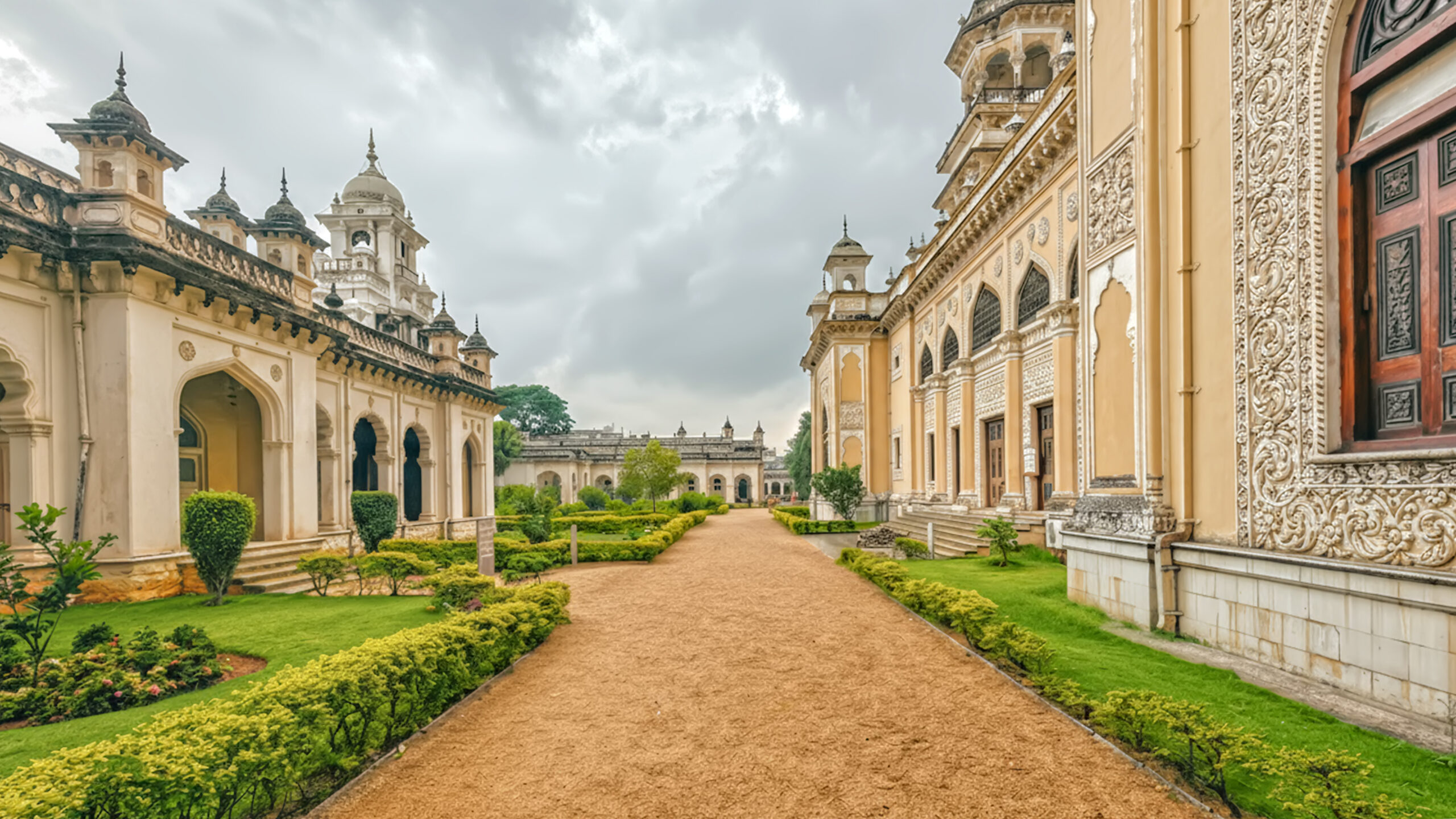
Among the most recognisable of Hyderabad’s royal buildings, Chowmahalla Palace was the ceremonial centre of the Asaf Jahi state. Its development extended across generations of Nizams, beginning in the eighteenth century under Salabat Jung and taking shape through successive additions and alterations. The complex was not conceived as a single building but as a sequence of courts, palaces, halls and service spaces.
The name refers to four palaces: Afzal Mahal, Aftab Mahal, Mahtab Mahal and Tahniyat Mahal. The most imposing ceremonial space is the Khilwat Mubarak, the durbar hall whose present form is associated with the reign of the seventh Nizam, Mir Osman Ali Khan. Its great hall, chandeliers and marble platform evoke the formal rituals through which the Nizam received officials, nobles and visiting dignitaries.
The scale of the original estate has contracted sharply. What was once a much larger royal complex is now a fraction of its former extent, but the surviving buildings retain an unusually complete sense of the court’s ceremonial life. The palace’s restoration, recognised with a UNESCO Asia-Pacific Award of Merit in 2010, helped return it to public view as a heritage site and cultural institution.
Princess Esra and the return of two royal landmarks
The revival of Chowmahalla and Falaknuma is closely associated with Princess Esra Birgen Jah, whose role went well beyond ceremonial patronage. After returning to Hyderabad in the 1990s, she confronted the deteriorating condition of important properties belonging to the former ruling family. She took the lead in bringing together conservation specialists, architects, craftspeople and institutional partners, and remained closely involved in decisions about how the buildings and their contents should be preserved.
At Chowmahalla, the work required more than repairing façades. The palace had to be documented, its architectural fabric stabilised and its collections identified and conserved. Architect Rahul Mehrotra and conservationist Martand Singh were among the specialists associated with the project. Traditional materials and techniques were brought back into use, while archival objects, furnishings and photographs helped recover the story of the court. The palace’s restoration was a collective undertaking, but Princess Esra provided its driving leadership and insisted that the complex retain its historical character.
Her involvement in Falaknuma was equally significant, though the restoration followed a different model. The palace was developed as a luxury heritage hotel in partnership with the Taj Group. Princess Esra worked with the project team to safeguard its character, from the treatment of interiors and furnishings to the integration of modern services. The hotel reopened in 2010, giving a building that had remained closed and deteriorating a new use.
It is important to distinguish these projects from the wider conservation story of Hyderabad. Princess Esra’s documented leadership is most clearly associated with Chowmahalla and Falaknuma; the restoration and continued use of other historic properties have involved different trusts, institutions and custodians.
Falaknuma: a Paigah palace above the city
Falaknuma’s story begins not with a Nizam but with a nobleman of the Paigah family. Sir Vikar-ul-Umra commissioned the palace in the late nineteenth century, with construction beginning in 1884. Set on a hill overlooking the old city, its design drew strongly on European architectural ideas, including the vocabulary of Italianate and Palladian buildings. Marble staircases, formal reception rooms, a long dining table and carefully composed views announced the cosmopolitan ambitions of its owner.
The sixth Nizam, Mir Mahbub Ali Khan, acquired the property in 1897. It subsequently became associated with the Nizam’s household and visiting royalty. The palace’s position above Hyderabad gave it a symbolic as well as a physical prominence: a private aristocratic project had become part of the visual language of the state.
Falaknuma is also a reminder that the city’s architectural history cannot be told through the Nizams alone. The Paigahs were among the most influential noble families of Hyderabad, with close marital and political ties to the ruling house. Their estates, residences, tombs and public patronage formed a parallel world of power and prestige.
Purani Haveli: a palace with a public afterlife
Purani Haveli belongs to a different phase of the city’s history. The site is associated with Mir Momin, the prime minister of the Qutb Shahi ruler Muhammad Quli Qutb Shah. In 1777, the second Nizam, Mir Nizam Ali Khan, acquired the property for his son Sikandar Jah. When Sikandar Jah became Nizam in 1803 and moved to Chowmahalla, the residence came to be known as Purani Haveli, or the old palace.
The complex is closely associated with the sixth Nizam, Mir Mahbub Ali Khan, and is known for its remarkable long teak wardrobe, often described as one of the longest of its kind. The Nizam’s Museum, established in 2000, preserves gifts and objects associated with the seventh Nizam, including presents marking the silver jubilee of his reign in 1936.
Purani Haveli’s story continues beyond its royal associations. Parts of the complex have been adapted for educational use, and restoration work has brought attention to the possibility of giving historic buildings a continuing civic purpose. GAWAH has previously reported on the restoration of the Asaf Jahi Wing and the educational activities associated with the Mukarram Jah School.
The Paigah legacy beyond the palace gates
The Paigahs were not merely wealthy courtiers. They occupied a distinctive position within the Hyderabad state, maintaining their own estates and military responsibilities while remaining closely connected to the Nizam through service and marriage alliances. Their architectural legacy is visible in residences across the city and, perhaps most strikingly, in the Paigah Tombs at Pisal Banda.
The tomb complex is known for its intricate stucco work, carved marble screens, geometric patterns and delicate ornament. It is a different kind of monument from the great residential palaces: a family necropolis in which architecture, craftsmanship and memory were brought together. Its significance lies as much in the quality of its detail as in the political stature of the people buried there.
Other aristocratic residences extended this landscape. Asman Garh, associated with Sir Asman Jah, occupied a hilltop setting and was designed with a castle-like silhouette. Parts of the historic structure were demolished in 2021, an episode that underlined how vulnerable Hyderabad’s built heritage remains. Bashir Bagh Palace, associated with the same aristocratic world, has disappeared. Iram Manzil, built by Nawab Fakhr-ul-Mulk, survives as another important example of the European-influenced residences commissioned by Hyderabad’s elite.
From royal residences to public institutions
Not every palace has become a museum or a hotel. King Kothi, associated with the seventh Nizam, Mir Osman Ali Khan, is remembered as the residence from which he governed during the later part of his reign. The estate once comprised several buildings and gardens; parts were lost or repurposed, and the surviving complex acquired a very different public identity. Bella Vista, another royal-era residence, now houses the Administrative Staff College of India, giving the building an institutional life far removed from its original use.
These changes are not all examples of successful conservation. Some buildings have been adapted with care, others have lost important sections, and several have vanished from the city’s physical landscape. The history of Hyderabad’s palaces is therefore also a history of decisions about land, ownership, urban expansion and the value placed on architectural memory.
A heritage that belongs to the city
The palaces of Hyderabad are often presented as symbols of princely splendour. Their deeper value lies in what they reveal about the making of the city: the relationship between rulers and nobles, the movement of architectural ideas, the work of artisans and the changing uses of historic space.
The restoration of Chowmahalla and Falaknuma demonstrated what sustained leadership, specialist knowledge and institutional partnership can achieve. The future of the remaining palaces and mansions will depend on the same combination of commitment and expertise, along with public recognition that these buildings are not simply remnants of a vanished court. They are part of Hyderabad’s shared inheritance.
Further reading and sources
- Chowmahalla Palace: official history and legacy
- Telangana Tourism: Falaknuma Palace
- Architectural Digest India: How to Restore Your Palace
- The Telegraph: Return of the Royals
- ELLE Decor India: Princess Esra Birgen Jah
- Omar Khalidi, A Guide to Architecture in Hyderabad, Deccan, India
- Hyderabad District: Paigah Tombs
- The New Indian Express: Asman Garh Palace demolition
- GAWAH: The Nizam’s Palace That Became a School
Photograph: Chowmahalla Palace, Hyderabad. Image by Donvikro, Wikimedia Commons, licensed under CC BY-SA 4.0.