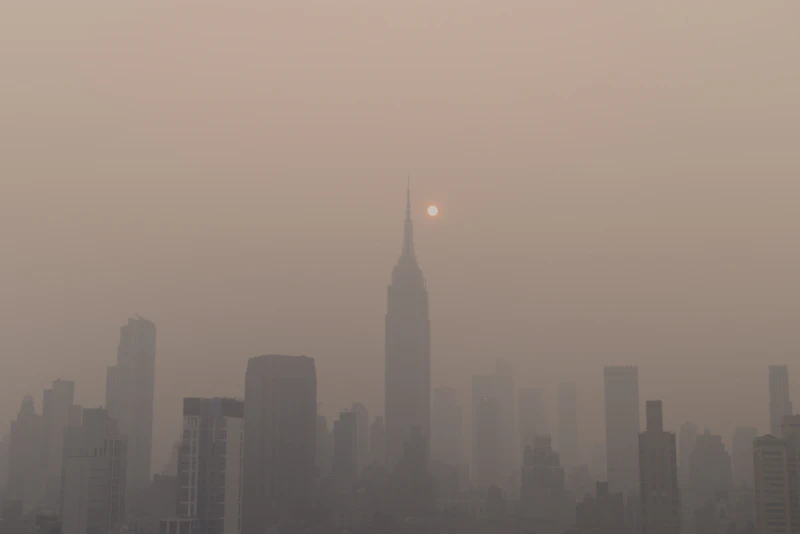
Have you checked the air quality before going for a run, cycling to school or playing outdoors? You may have seen a number called the Air Quality Index (AQI). It turns measurements of air pollution into a single, easier-to-understand score. In India, the official National AQI uses six categories, from Good to Severe.
Air quality became a practical search topic in India: Google’s Year in Search 2025 listed “Air Quality near me” among its trending “Near Me” searches. That is evidence of public interest in local air conditions—not proof that every city or day has the same pollution level.
What does AQI mean?
AQI stands for Air Quality Index. Monitoring stations measure pollutants in the air, and those measurements are converted into an index number and a category. The score helps people understand air quality without having to interpret several scientific measurements separately.
India’s National AQI considers eight pollutants: PM10, PM2.5, nitrogen dioxide (NO₂), sulphur dioxide (SO₂), carbon monoxide (CO), ozone (O₃), ammonia (NH₃) and lead (Pb). The overall AQI is determined by the highest pollutant sub-index when the required data are available; it is not simply an average of all pollutants. Read the Central Pollution Control Board’s explanation of the National AQI.
India’s six AQI categories explained
| AQI number | Category | What it generally means |
|---|---|---|
| 0–50 | Good | Minimal impact is expected. |
| 51–100 | Satisfactory | Some sensitive people may experience minor breathing discomfort. |
| 101–200 | Moderate | People with asthma or other lung or heart conditions, children and older adults may be more affected. |
| 201–300 | Poor | Prolonged exposure may cause breathing discomfort to more people. |
| 301–400 | Very Poor | Prolonged exposure may increase the risk of respiratory illness. |
| 401–500 | Severe | Health effects may occur even among healthy people; people with existing heart or lung conditions face greater risk. |
These are broad descriptions, not a diagnosis or a guarantee of how any individual will feel. The CPCB’s National AQI portal provides the official category ranges and associated health-impact guidance.
What are PM2.5 and PM10?
PM means particulate matter—tiny solid particles or liquid droplets suspended in air. The number describes particle size:
- PM10: particles with a diameter of 10 micrometres or less. Dust and some road or construction particles can contribute.
- PM2.5: particles with a diameter of 2.5 micrometres or less. They are smaller and can travel deeper into the lungs.
Both can affect health. PM2.5 is especially concerning because its small size allows it to penetrate deep into the respiratory system. Sources vary by place and season and can include vehicle exhaust, industry, construction dust, burning and other combustion.
Why can AQI change during the day?
Air pollution is not spread evenly. Traffic, construction, industrial activity, weather, wind and the height at which air mixes can all affect readings. Rain may temporarily wash some particles out of the air, while still weather can allow pollution to build up. A reading at one monitoring station may not represent every neighbourhood in the same city.
How can students check AQI and use the information?
- Check the CPCB’s official AQI dashboard and select a relevant monitoring station where data are available.
- Look at the time of the reading and the specific station, not just a city-wide headline or an old screenshot.
- If the AQI is poor or worse, consider reducing prolonged or strenuous outdoor activity, especially if you have asthma or another heart or lung condition. Follow local public-health advice.
- If you develop breathing difficulty, chest pain or severe symptoms, seek appropriate medical help rather than relying on an AQI number alone.
- Remember that AQI is an outdoor air-quality indicator; indoor air can differ.
Quick questions about AQI
Is a higher AQI better or worse?
A higher AQI means worse air quality and generally greater potential health concern.
Does one AQI number describe every part of a city?
No. Readings can vary between monitoring stations and neighbourhoods. Check the station location and timestamp.
Can I tell whether air is safe just by looking at it?
No. Haze can be visible, but some pollutants are invisible. Use current monitoring data rather than relying on appearance or smell alone.
Where can I find India’s official AQI?
Start with the Central Pollution Control Board’s National AQI portal. Availability and freshness of readings can vary by station.
The takeaway
AQI makes complicated air-pollution measurements easier to understand. Learn the six Indian categories, check the latest official reading for a relevant station, and use the result to make sensible decisions about outdoor activity—especially when air quality is poor.
Sources: Central Pollution Control Board (National Air Quality Index guidance and dashboard); Google India, “India’s Year in Search 2025: The A to Z of Trending Searches.”