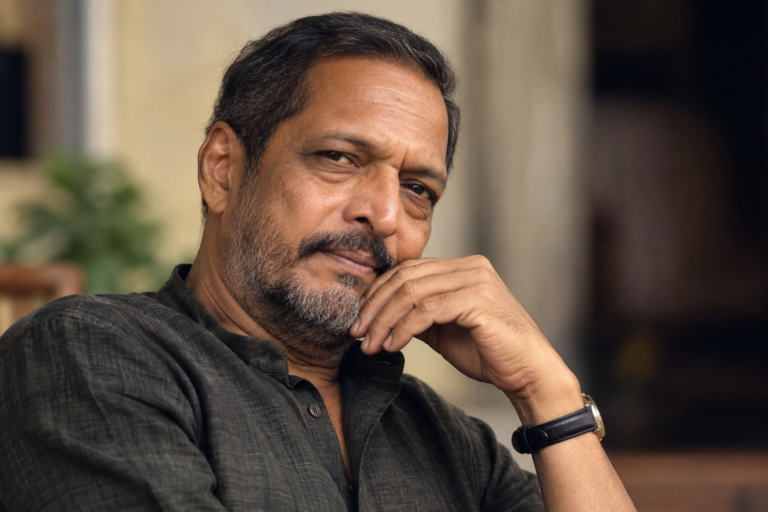
More than three decades after Krantiveer, its unforgettable dialogue against communal hatred remains a challenge to India’s political conscience.
In Krantiveer (1994), Nana Patekar’s character, Pratap Narayan Tilak, confronts a crowd with a question that would become one of Hindi cinema’s most enduring challenges to communal hatred:
“Yeh Musalman ka khoon, yeh Hindu ka khoon… bata, ismein Musalman ka kaunsa, Hindu ka kaunsa?”
This is a Muslim’s blood, this is a Hindu’s blood. Tell me, which is Muslim and which is Hindu?
The dialogue was written by K. K. Singh, who won the Filmfare Award for Best Dialogue for Krantiveer. Patekar’s forceful performance helped turn the words into one of the film’s most enduring moments.
The power of the scene lies in its simplicity. Blood carries no religious label. Yet societies can be persuaded to treat people differently because of the faith they follow.
Released in 1994, against the backdrop of the Babri Masjid demolition and the communal violence of 1992–93, Krantiveer addressed divisions that had already inflicted enormous damage on Indian society. Patekar’s performance transformed that concern into a question audiences could not easily forget.
Today, the dialogue resonates against the backdrop of reported mob lynchings, hate crimes against Muslims and concerns over Islamophobia in India. These incidents raise difficult questions about minority safety and the gap between the constitutional promise of equality and the lived experiences of vulnerable communities. Religious identity must never become a licence for hatred or violence.
When faith becomes a political dividing line
Religion is central to the lives of millions of Indians. It shapes traditions, values, families and communities. The challenge arises when religious identity becomes a reason to suspect fellow citizens, assign collective blame or question their belonging.
India’s communal politics has a complex history spanning different regions, parties and periods. But one recurring concern remains: the use of religious identity to mobilise people by presenting another community as a threat.
When a politician makes a claim about a religious community, citizens should ask whether it is supported by evidence or relies on a stereotype. When violence occurs, responsibility must be established through investigation rather than assigned to an entire religious group. When inflammatory messages circulate online, verification must come before amplification.
None of this prevents legitimate criticism of religious institutions, political organisations or public figures. Democracy requires debate and accountability. The distinction is between questioning specific actions and condemning people simply because of their faith.
That distinction is central to the message of Krantiveer.
The constitutional promise
The Constitution of India provides a framework for coexistence.
Article 14 guarantees equality before the law. Article 25 protects freedom of conscience and religious practice, subject to constitutional limitations. Article 51A(e) identifies the promotion of harmony and common brotherhood across religious, linguistic and regional differences as a fundamental duty of citizens.
These principles do not ask Indians to surrender their religious identities. They ask that those identities coexist with equal citizenship.
A Hindu should not have to demonstrate patriotism by expressing hostility towards a Muslim. A Muslim should not have to repeatedly prove belonging because of their faith. The same principle applies to citizens of every religion.
Political leaders must be judged by their words and actions. The media, too, has a responsibility to report communal tensions accurately, verify claims and provide context rather than amplify rumours.
The question that remains
India’s diversity does not require its citizens to agree on everything. It requires them to recognise that disagreement need not become hatred, and that religious identity should not determine a person’s worth as a citizen.
Nana Patekar’s performance endures because it strips away the rhetoric surrounding communal division and returns the audience to a fundamental question.
If human blood carries no religious label, what justifies treating the person it belongs to as an enemy?
More than three decades after Krantiveer, that question remains unanswered—not because its meaning is difficult to understand, but because living up to it demands something of every one of us.
The dialogue was delivered on a cinema screen. The answer must be written in the conduct of the republic.