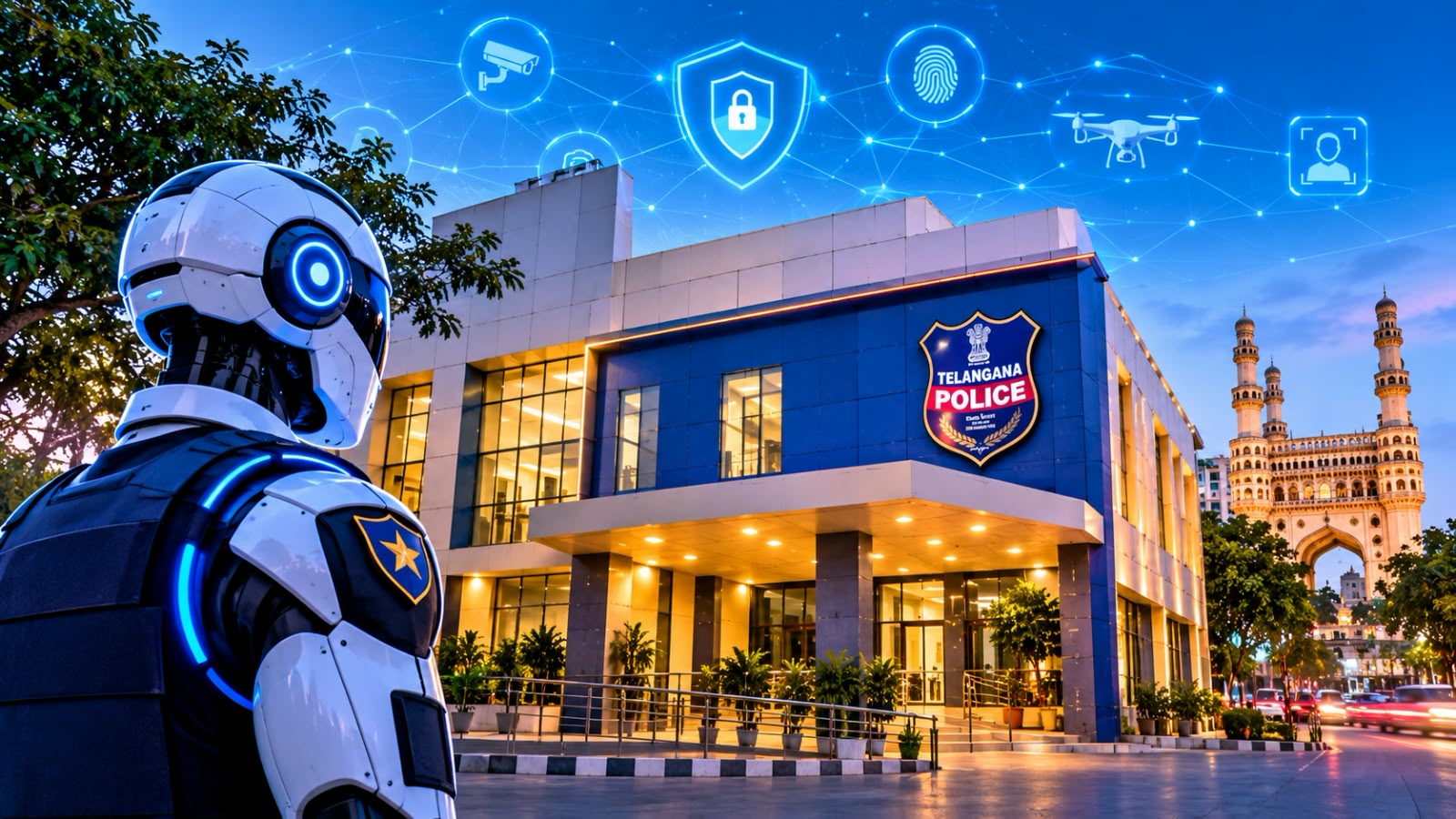
Hollywood-style RoboCops, with human-like machines taking charge of crime-fighting, remain a distant dream. But artificial intelligence is already making its way into policing, not as a replacement for officers, but as an increasingly capable, full-service assistant: helping receive complaints, translate statements, prepare reports, analyse information and support investigations. Hyderabad’s proposed AI-powered police station at Punjagutta is part of this transition.
HYDERABAD: A person walks into a police station to report a crime. Instead of struggling to explain the incident in an unfamiliar language, the complainant may be able to submit the grievance through an AI-enabled system. The statement can be recorded, translated and routed to the appropriate officials. Further along the process, technology could help police personnel organise case information and prepare investigation documents.
This is the model Hyderabad is preparing to pilot at Punjagutta Police Station. The initiative is being described by officials as India’s first AI-powered police station and is intended to bring artificial intelligence into several stages of police work, from receiving complaints and registering First Information Reports (FIRs) to preparing case diaries, investigation reports and charge sheets.
The project moved another step forward on November 25, when senior Telangana and Hyderabad police officials inspected the station and reviewed the technical arrangements. The pilot is still being developed; it should not yet be mistaken for a fully operational AI police station.
Hyderabad’s experiment builds on earlier pilots
The Punjagutta initiative follows Hyderabad’s own experiments with AI-assisted public services.
In September 2026, Hyderabad City Police introduced SETU, an AI-enabled grievance kiosk at Mehdipatnam Police Station. It allows citizens to submit complaints in a language they are comfortable with. The system digitally records the statement, provides an acknowledgement and gives the complainant information about the next steps. A similar kiosk has been installed at Punjagutta.
Hyderabad Police have also introduced AI-CopWriter, a tool designed to convert spoken complaints into draft FIRs, with transcription and translation support across Indian languages. These projects point to a gradual move from digitising police services to using AI to assist with the work that follows a complaint.
The larger Punjagutta project is intended to extend AI assistance beyond the reception counter. Reported applications include documentation connected with investigations and analysis of local information such as traffic congestion, hostels and commercial establishments. Such information could help officers plan patrol deployment and allocate resources.
The distinction matters. A complaint kiosk is a digital public-service tool. An AI-assisted police station attempts to connect public-facing services with the administrative and investigative work that follows.
Singapore has connected AI to the investigation process
One of the closest international comparisons comes from Singapore.
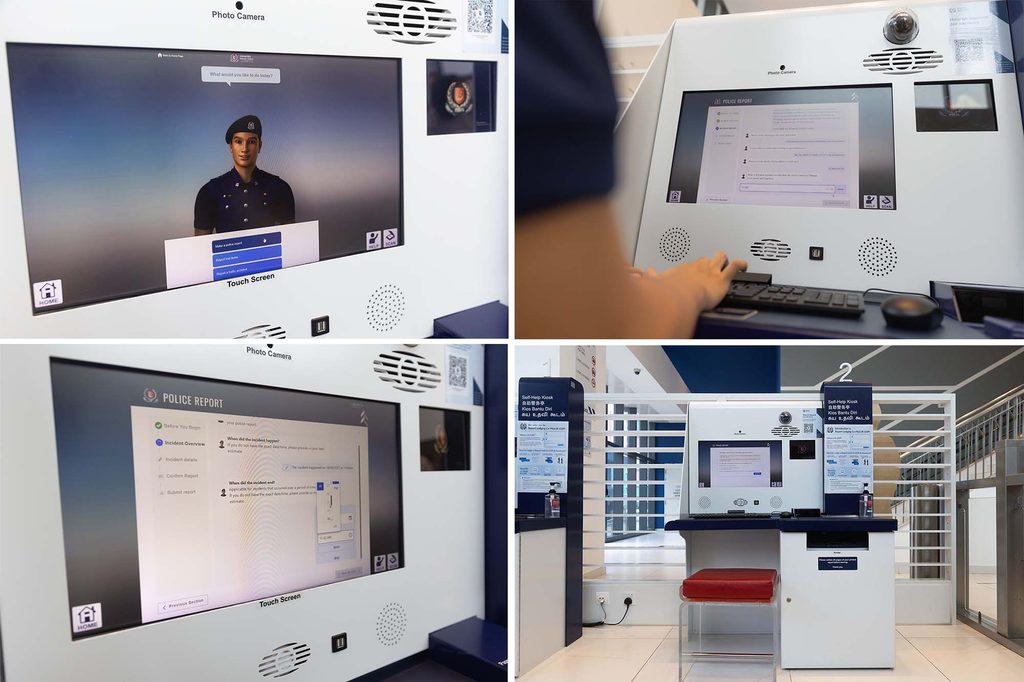
The Singapore Police Force introduced its AI-enabled Report Lodging Co-Pilot, known as R-COP, at self-service kiosks in 2025. The system guides citizens through questions based on the incident they are reporting and prepares a draft police report. The complainant can review and edit the draft before submission.
The objective is practical: people reporting an incident may not know which details are important. An AI-guided process can prompt them to provide relevant information at the beginning, reducing the need for investigators to repeatedly contact complainants to fill in missing details.
Singapore has also developed AI tools to support investigators, including assistance with case summaries and the review of information from different sources. These tools are designed to support police personnel, not replace their judgement.
For Hyderabad, the Singapore experience offers two useful lessons: citizens should be able to review AI-generated reports before submission, and officers must remain responsible for the accuracy of official records.
Dubai’s smart police stations focus on public access
Dubai’s Smart Police Stations offer a different comparison. Introduced in 2017, these facilities allow people to access a range of police services through digital, self-service systems, often without needing to interact with an officer at a traditional counter.

Their emphasis is on accessibility, round-the-clock service and reducing dependence on conventional administrative procedures. They are not identical to Hyderabad’s proposed model: Dubai’s stations are primarily known for digital self-service, while Punjagutta’s stated ambition includes AI assistance in station-level documentation and police work.
The UK is building a national AI framework for policing
The United Kingdom has taken a broader, national approach. PoliceAI, a national centre launched in 2026, is intended to coordinate the development and adoption of AI across police forces in England and Wales. Bobbi, UK’s first Police AI agent has already been launched, handling upto 200 non-emergency conversations a day, according to Salesforce data.
Its areas of work include helping officers review and summarise digital evidence, transcribe calls, analyse media and identify patterns across crime reports. The objective is to reduce time spent on repetitive administrative work and allow officers to focus more on investigation and public-facing duties.
This is different from a station-level pilot, but the underlying question is similar: how can AI assist routine police work without compromising accuracy, privacy or due process?
Robot cops are moving from science fiction to police trials
Hyderabad’s AI-policing experiment is part of a wider shift in which police forces are testing machines that can patrol public spaces, relay live information and take on repetitive tasks. These systems are not all humanoid robots, and most are designed to assist officers rather than replace them.
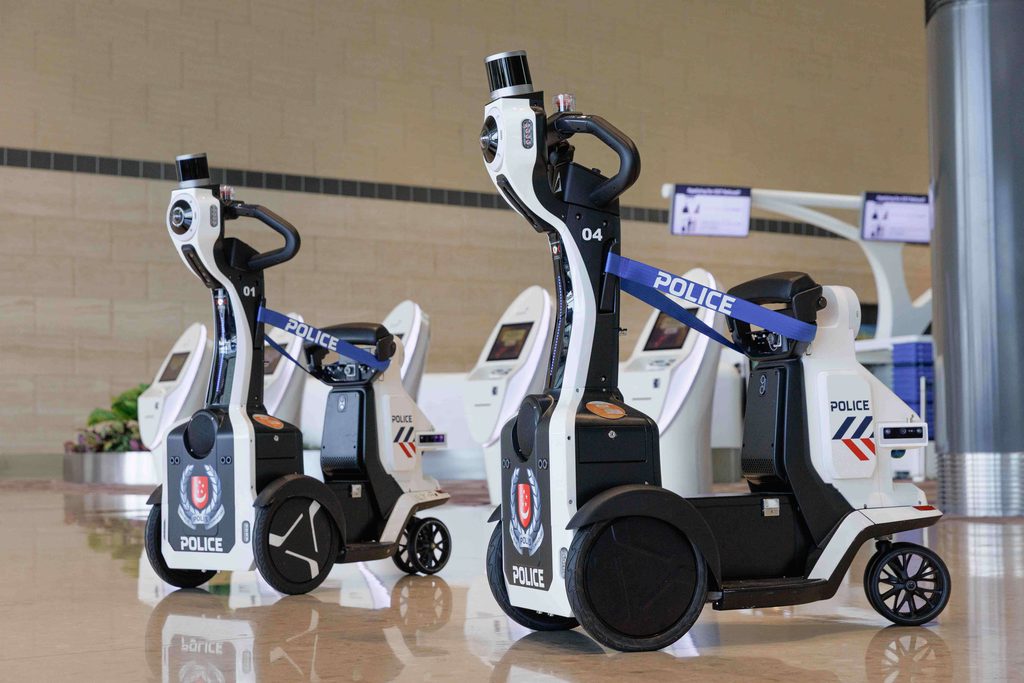
Singapore: autonomous patrol robots at Changi Airport
The Singapore Police Force has deployed patrol robots at Changi Airport Terminal 4 since April 2023. The machines provide an additional set of eyes, use cameras and sensors to build a picture of their surroundings, and can communicate with people through speakers and displays. In July 2025, the Airport Police Division began trialling GIBSON, a rideable robot platform that can operate autonomously or carry officers across the terminal. The model is designed to extend patrol presence and improve officers’ mobility, not to function as an independent police officer.
China: rolling robots and traffic-policing machines
In Wenzhou, Zhejiang province, police have taken a spherical, remotely mobile robot on patrol alongside officers. Reported capabilities include cameras, flashing lights and the ability to track and pursue a target; the device can also be equipped with suppression tools. The deployment illustrates a more intervention-oriented use of ground robots, although it remains distinct from a human officer’s legal authority and judgement.
Spain: a robot dog on trial in Malaga
In March 2024, police in Malaga trialled a four-legged robot developed by researchers at the University of Malaga. The prototype was designed to help monitor public spaces and identify traffic violations, including electric scooters being used in prohibited areas. At the time of the trial, it was remotely controlled, with artificial intelligence intended as a future development. It was an experiment, not an autonomous police dog operating independently.
Dubai: autonomous patrol vehicle at Global Village
Dubai has moved beyond demonstrations with the DPR-02 autonomous patrol vehicle. A Dubai Future Foundation report published in October 2026 says the vehicle entered operational duty at Global Village on 15 October 2025, with cameras, AI functions and facial-recognition capability, and a live connection to police operations. Its role is to patrol a defined public venue and support police teams.
These examples show that the phrase “robot cop” covers very different technologies: wheeled patrol platforms, spherical pursuit robots, four-legged monitoring prototypes and autonomous vehicles. Their common purpose is to extend surveillance, improve situational awareness and handle routine tasks. Decisions involving arrest, use of force, evidence and accountability remain matters that require clear human and legal oversight.
What should an AI-powered police station actually deliver?
For the public, the value of the Punjagutta experiment will ultimately be measured by everyday experiences.
- Can a person lodge a complaint in a preferred language without unnecessary difficulty?
- Will the system provide an acknowledgement and a way to track the grievance?
- Can it reduce delays caused by incomplete documentation?
- Will officers spend less time preparing routine paperwork and more time investigating cases?
- Can citizens correct errors in AI-generated transcripts or reports?
There are equally important questions about accountability. An AI system can misunderstand a statement, mistranslate a crucial detail or produce an inaccurate summary. A draft FIR or investigation report must therefore be checked by authorised personnel. Technology should assist the officer, not replace the officer’s responsibility for the accuracy and legality of official records.
The handling of personal information also deserves close attention. Police records can contain sensitive details about complainants, witnesses and accused persons. Citizens should know how their information is collected, stored, accessed and protected. There must also be a clear process for correcting errors and challenging decisions.
A pilot, not yet a finished model
Hyderabad’s proposal is an important development in the evolution of technology-enabled policing. But the distinction between a pilot and a proven system must remain clear.
The coming months should reveal whether the technology works reliably under the pressure of everyday police operations, whether it is accessible to people with different levels of digital literacy, and whether it genuinely reduces the workload of station personnel.
Singapore shows how AI can assist with report lodging and investigations. Dubai demonstrates how digital police services can reduce dependence on conventional counters. The UK is building a national framework for AI adoption. Hyderabad’s next challenge is to turn the promise of an AI-powered police station into a service that citizens can trust.
The most meaningful measure of success will not be how many AI tools are installed inside Punjagutta Police Station. It will be whether a citizen receives a more accessible, timely and accountable response when they need the police.
Further reading
- Singapore Police Force: Report Lodging Co-Pilot
- Singapore Ministry of Home Affairs: Police Workplan 2026
- UK: Launch of PoliceAI
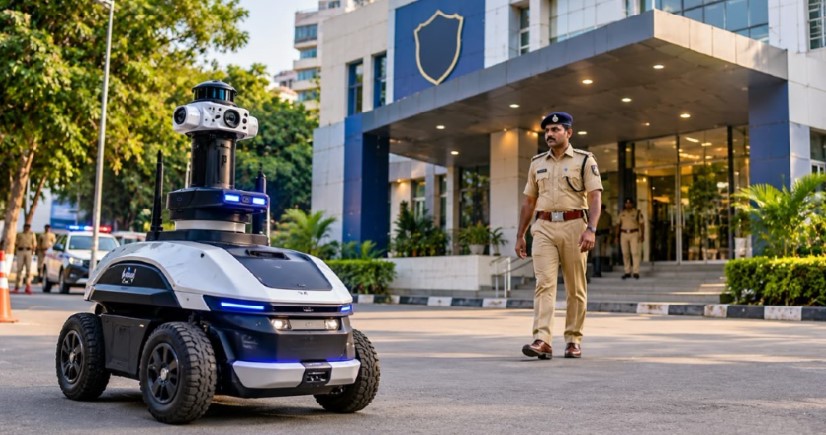
Image: Representative photograph of a police station. Featured cover photo is not a photograph of Punjagutta Police Station.