A claim involving Anthropic’s Claude has brought one of mathematics’ most famous unsolved problems back into the spotlight. Levent Alpöge, a mathematician on Anthropic’s technical staff, says he believes he has found a proof of the Riemann Hypothesis while working with the company’s artificial intelligence system.
The conjecture, formulated by German mathematician Bernhard Riemann in 1859, concerns the distribution of prime numbers. It has remained unresolved for more than 160 years and is one of the seven Millennium Prize Problems selected by the Clay Mathematics Institute, which offers a $1 million prize for an accepted solution.
Alpöge published a four-page explanation of the proposed proof and said the work had been formalised in approximately 17 million lines of Lean code. Lean is a proof-assistant language that allows mathematical arguments to be expressed in a form that software can check step by step.
That is a significant development, but it is not the same as the mathematical community accepting that the problem has been solved. The Associated Press reported that Rutgers mathematician Alex Kontorovich had not yet independently understood the proof. The Clay Mathematics Institute continued to list the Riemann Hypothesis as unsolved at the time of the announcement. Its president said that the process of moving from an announcement to a shared mathematical understanding would be long and difficult.
What is the Riemann Hypothesis?
At its centre is the Riemann zeta function, a mathematical function connected to the way prime numbers are distributed. The hypothesis states that all non-trivial zeros of this function lie on a particular vertical line in the complex plane, where the real part is one-half.
That may sound abstract, but the question has deep consequences for number theory. Prime numbers are the basic building blocks of whole numbers, and the Riemann Hypothesis would give mathematicians a much sharper understanding of how regularly or irregularly primes appear among larger numbers.
Why the role of AI matters
AI systems are increasingly being used to explore difficult mathematical problems, test ideas, assist with symbolic reasoning and translate arguments into formal proof systems. A proof assistant can check whether a formal sequence of steps follows the rules encoded in the system. That is valuable because even a small logical gap can invalidate a proof.
However, specialists must still examine whether the formal work accurately represents the original mathematical claim and whether the reasoning is complete. Independent review is essential, especially for a problem that has challenged generations of mathematicians.
The announcement therefore raises two separate questions: whether the proposed proof is correct, and how far AI can assist researchers in producing and checking mathematics. The first question remains open. The second is already changing the way mathematicians work.
As of November 21, 2026, the Riemann Hypothesis should still be described as an unsolved problem with a newly announced proof claim under scrutiny, not as a theorem conclusively settled by AI.
Sources: The Associated Press; Nature; Clay Mathematics Institute.
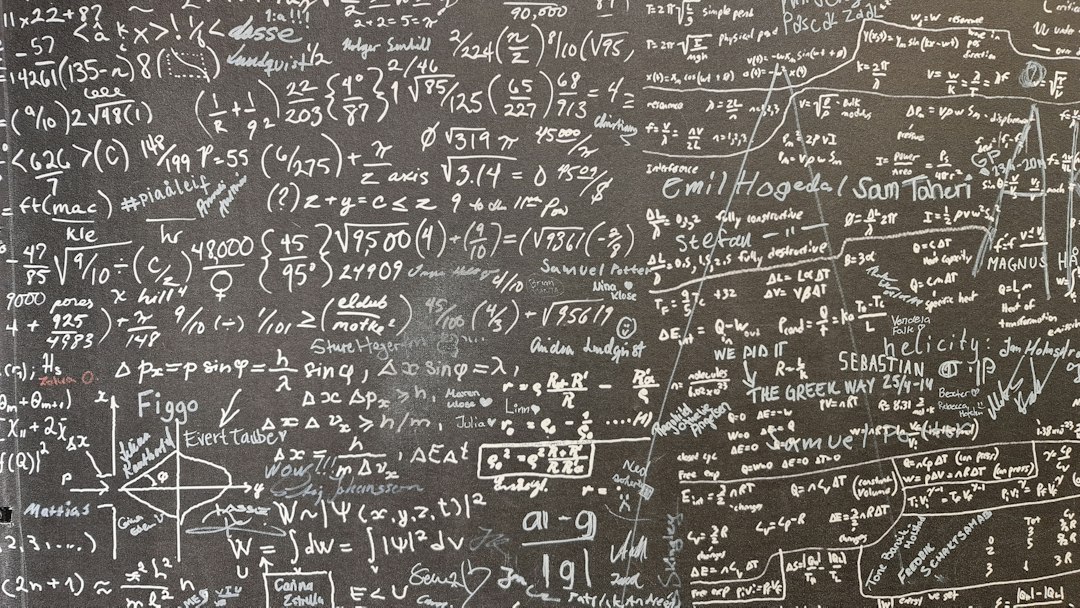
Featured image: Mathematical equations on a blackboard. Illustrative photograph by Thomas T via Unsplash.