GAWAH News Desk | November 1, 2026
A meteorite discovered in the Sahara Desert in 2022 has given scientists an unusually old sample of Mars to study. Named Teghaza 001, the rock formed more than 4.1 billion years ago and preserves mineral evidence of interactions between water and the Red Planet’s early crust. A NASA-funded study describing the meteorite was published in the journal Science on October 29, 2026.
The finding does not mean scientists have discovered life on Mars. Instead, it adds a rare physical record of the planet’s earliest geological history, when magma was cooling and water was altering rocks beneath the surface.
What is Teghaza 001?
Teghaza 001 is a Martian meteorite found in 2022 near Bir Chali in Mali, in the Sahara region. The name comes from the nearby Teghaza salt plain. The specimen consists of several fragments with a combined mass of about 800 grams, making it a small but scientifically valuable piece of another planet.
NASA describes it as one of the most ancient Martian meteorites found on Earth. It is among a small group of exceptionally old samples that preserve clues from the Red Planet’s early crust and mantle.
How old is the Martian meteorite?
Researchers determined that Teghaza 001 formed at least 4.1 billion years ago. Its minerals record an ancient period when Mars was geologically active. The rock formed as magma cooled and crystallised; later, water-bearing fluids altered some of its minerals while it was still on Mars.
The meteorite is not simply a piece of ancient surface sediment. Its mineral mixture provides information about the formation of the crust and material originating deeper in the planet.
How did scientists confirm that it came from Mars?
Planetary scientists use chemical and isotopic fingerprints to distinguish rocks from different worlds. Researchers identified oxygen-isotope signatures in Teghaza 001 that match those found in other Martian meteorites. Its mineral chemistry can also be compared with measurements made by NASA spacecraft studying Mars.
The team found zircon crystals, which can preserve information about when a rock formed. Zircon contains trace uranium that decays into lead at a predictable rate, allowing scientists to estimate geological age. Researchers also used an in-situ rubidium-strontium dating technique on a mineral sample smaller than a fingernail. The approach helped preserve most of the rare meteorite for future research.
What does it reveal about water on ancient Mars?
The minerals and isotopic evidence indicate that water interacted with the rock deep within Mars’ crust around 4.1 billion years ago. NASA says the results point to a more dynamic water cycle on early Mars than the dry planet seen today.
The study also identified 13 possible regions on Mars whose mineralogy and chemistry resemble the meteorite. These candidate locations include parts of the planet’s southern highlands. Scientists cannot identify the exact place where the rock originated, but the comparison gives researchers a way to narrow the possibilities.
Does this mean there was life on Mars?
No. Water is considered an important ingredient for life as we know it, and evidence that water interacted with ancient Martian rocks helps scientists assess whether parts of Mars may once have been habitable. But Teghaza 001 contains no confirmed evidence of past or present life. The discovery is about the planet’s geology and ancient environment, not a detection of organisms or fossils.
How did a rock from Mars reach the Sahara?
Scientists believe a powerful impact on Mars blasted the rock away from the planet’s surface and into space. It then travelled through the Solar System before entering Earth’s atmosphere and surviving the fall as a meteorite. Researchers do not know when Teghaza 001 landed on Earth; its discovery in 2022 is not the date of its fall.
Why is this discovery important?
Only a limited number of Martian meteorites are available for detailed laboratory study, and very few preserve material from the planet’s earliest history. Teghaza 001 offers a different combination of age, texture and minerals from many previously studied samples. It can help scientists test interpretations made from spacecraft observations and guide future exploration of Mars’ ancient crust.
The NASA-funded research was led by planetary scientist Yang Liu and collaborators. NASA’s Jet Propulsion Laboratory says further work on the meteorite may reveal more about how Mars’ crust formed and how water altered it.
Quick answers
- What is Teghaza 001? A Martian meteorite discovered in Mali’s Sahara region in 2022.
- How old is it? It formed more than 4.1 billion years ago.
- What does it show? Minerals record interactions between water and rock in Mars’ early crust.
- Does it prove life existed on Mars? No. It provides geological evidence of ancient water, not evidence of life.
- Where was it found? Near Bir Chali in Mali, in the Sahara Desert.
For a basic guide to space rocks, read GAWAH’s explainer on the difference between an asteroid, comet and meteor.
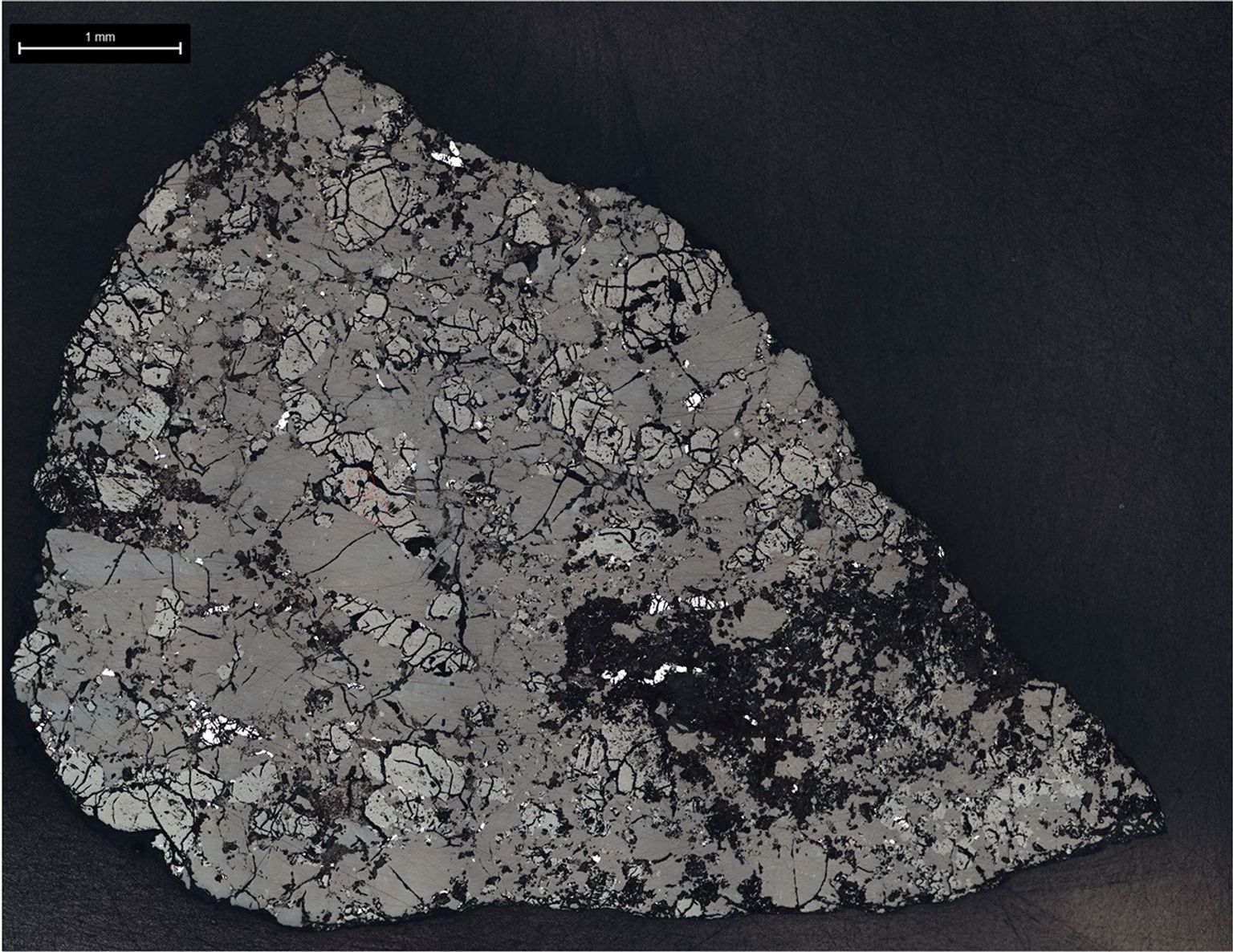
Featured image: A microscopic slice of Teghaza 001 used in the study. Credit: NASA/JPL-Caltech.
Sources and research
- NASA: NASA-funded study details one of the oldest Mars meteorites ever found (October 29, 2026)
- Science: A Martian meteorite that formed ≳4.1 billion years ago samples Mars’ early crust and mantle (2026)
- NASA Science Photojournal: Slice of Martian Meteorite Teghaza 001
- University of New Mexico research coverage (October 29, 2026)
- Reuters: Martian meteorite found in Sahara is 4.1 billion years old (October 29, 2026)