 Gawah (The Witness) – Hyderabad India Fearless By Birth, Pristine by Choice – First National Urdu Weekly From South India – Latest News, Breaking News, Special Stories, Interviews, Islamic, World, India, National News

What new health data from Hyderabad’s urban settlements reveals about disease, debt and responsibility
In many of Hyderabad’s urban settlements, illness is no longer confined to old age.
It is young. It is increasingly metabolic. And it is quietly reshaping the future of entire households.
Recent community health data drawn from more than 150 urban and peri-urban settlements reveals a troubling pattern. Between 35 and 40 percent of surveyed households reported hypertension, diabetes, or both. One in three adults was found to be overweight with central obesity. Nearly 70 percent of overweight adults were insulin resistant or pre-diabetic, many without knowing it.
Children and adolescents aged 0 to 17 accounted for 42 percent of those accessing community health services last year. Another 25 percent were young adults between 19 and 35. Health issues are increasingly centred around the younger cohort, the very population expected to carry families forward economically and socially.
Among young women, reproductive health disorders such as PCOS, PCOD, fibroids and irregular menstrual cycles are rising steadily. Among young men, head and neck cancers, particularly oral cancer linked to tobacco, gutka and paan consumption, remain alarmingly prevalent. Cases of non-alcoholic fatty liver disease, chronic kidney disease, and even heart and brain strokes are appearing earlier in life. What was once considered middle-age disease is steadily descending into the twenties and thirties.
The common denominator is not genetic inevitability. It is a lifestyle and environment. Poor diet. High exposure to processed foods. Improper sleep. Sedentary routines. Inadequate public spaces for physical activity. Delayed health-seeking behaviour. Financial hesitation before consultation.
In many of these settlements, 51 percent of residents report walking to health facilities to avoid transportation costs. Routine ailments treated at informal private clinics can cost between ₹500 and ₹1,000 per visit, a significant burden for families dependent on daily wages or informal work.
When healthcare access depends on proximity and affordability, prevention becomes a luxury.
And yet prevention is precisely what this moment demands.
When Illness Becomes Debt
Health, in these communities, is inseparable from economics.
Community health program data shows that 89.26 percent of beneficiaries reported improved household savings because primary care was free and accessible. More strikingly, 81.30 percent said they avoided borrowing money for treatment. Nearly half, 48.90 percent, said affordability prevented delays in seeking care.
Hospital support services alone translated into ₹44.21 crore in savings in a single year for patients requiring tertiary treatment. Over time, cumulative savings from free consultations, screenings, dialysis, rehabilitation and critical care interventions are estimated to exceed ₹100 crore.
To put that in perspective, ₹100 crore is roughly equivalent to the annual turnover of a mid-sized enterprise. It is capital that remained inside households rather than being lost to debt. For thousands of families, that has meant children staying in school, assets not being sold, and dignity preserved.
Illness here is not merely a medical episode. It is a financial shock.
The Diseases of a Young City
What makes the situation more urgent is the age profile. When nearly half of service users are children and adolescents, and another quarter are young adults, the burden is no longer marginal. It is generational.
A young population facing early insulin resistance, reproductive disorders, tobacco-related cancers and lifestyle-linked strokes carries consequences beyond individual suffering. It affects productivity, family stability and long-term social mobility.
Communities that are demographically young cannot afford to become medically old.
Gap Between People and the System
Much of the response to this crisis has centred not on building parallel systems, but on strengthening access to those that already exist.
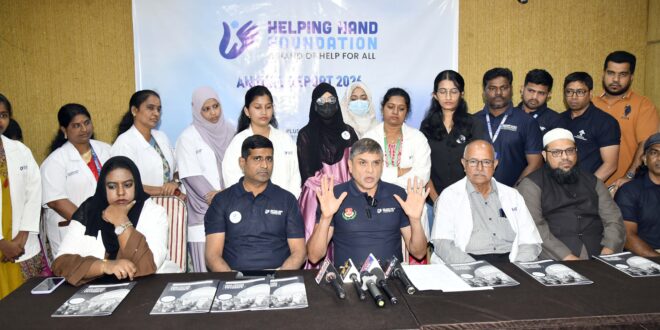
The community-led effort spearheaded by Helping Hand Foundation, under the leadership of Mujtaba Hasan Askari, and supported by donors such as SEED-USA and AMPI-USA, has focused on helping families navigate public healthcare infrastructure.
Government hospitals in Hyderabad are often equipped and staffed, yet underutilized by those who need them most. The barriers are rarely medical. They are procedural and psychological. Literacy challenges, paperwork complexity, lack of guidance and a lingering perception that government facilities are inadequate in hygiene or quality deter many families from seeking timely care.
Volunteers stationed at help desks across 17 State-run hospitals assist patients in locating the correct department, completing documentation, wheeling elderly patients into wards, coordinating diagnostics and guiding families through next steps. This support operates 24 hours a day, seven days a week, throughout the year.
Askari recalls that there was a time when late-night accident cases or emergency patients arriving on stretchers faced confusion or inadequate support. “Previously there used to be lack of support staff or unpreparedness when a late-night accident or emergency patient would be stretchered in,” he says. “Now it is not the case.”
From facilitating free cancer treatment that would otherwise cost lakhs in private hospitals to ensuring dialysis continuity and supporting complex cardiac procedures for underprivileged children, the effort has evolved from episodic assistance to structured intervention.
Today, a team of more than 400 staff and volunteers works across multiple zones of Hyderabad and adjoining districts, strengthening the bridge between vulnerable households and public institutions.
The United Strength of Volunteers
Perhaps the greatest asset is not infrastructure, but people.
Many volunteers earn modest incomes elsewhere, yet devote long hours to service. They describe the work not as sacrifice, but as fulfilment.
Imran, associated with the initiative for nearly two decades, says, “There is satisfaction you cannot buy. There are high-paying jobs for people like me, but none can match the satisfaction of helping people when you are in a position to.”
In communities where medical vulnerability intersects with economic fragility, such motivation becomes institutional strength.
Not Failure, But a Gap
None of this suggests that the government or policymakers are not doing enough. Hyderabad, as a major metropolitan city, possesses significant public healthcare infrastructure. The challenge lies in the gap between citizens and that system. Awareness deficits, procedural hurdles, literacy barriers and long-standing stigma about the quality or hygiene of government facilities often prevent people from utilizing services that are already available.
In a city with advanced hospitals and trained professionals, the disconnect is not necessarily about absence of infrastructure. It is about access, navigation and trust. Such gaps can be narrowed through informed community intervention. By guiding families through processes, restoring confidence in public institutions and ensuring that available services are actually accessed, organisations like Helping Hand Foundation demonstrate how civil society can complement state systems.
The data does not call for panic. It calls for seriousness.
A young, urban population is increasingly unwell. The financial consequences are immediate. The solutions require structure, persistence and trust.
And perhaps the most urgent question is not whether the system exists, but whether we are prepared to help our communities reach it.