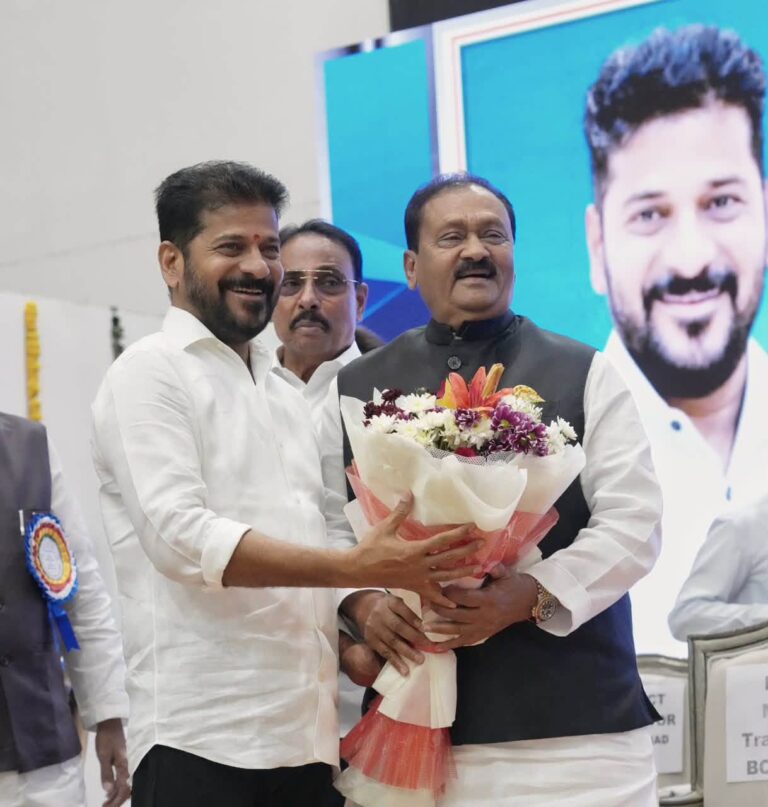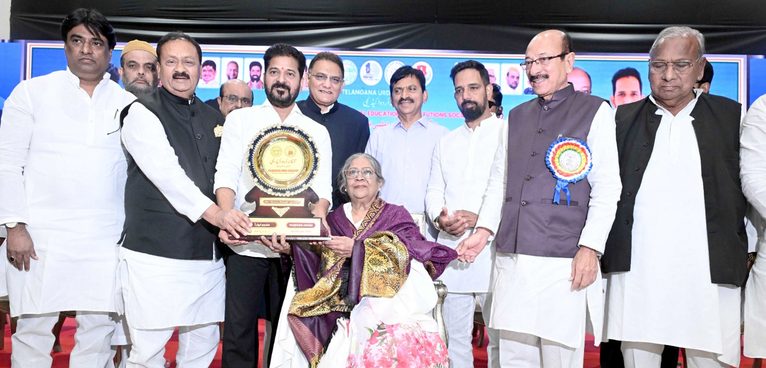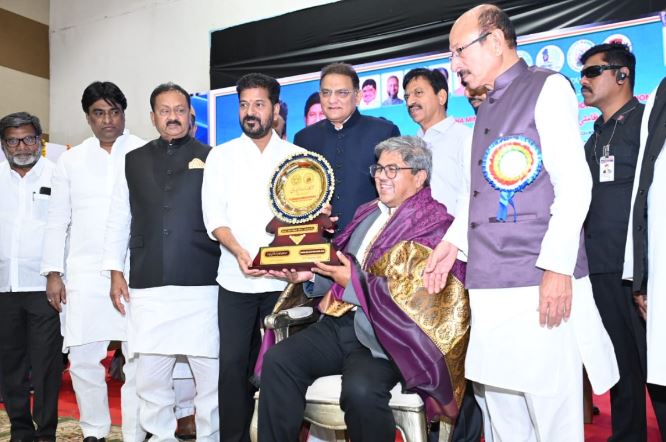
Hyderabad, November 11: Telangana Chief Minister A. Revanth Reddy on Wednesday presented the Maulana Abul Kalam Azad National Award to development economist Prof. Amir Ullah Khan and the Maqdoom Award to noted Urdu writer Qamar Jamali at the National Education Day and Minorities Welfare Day celebrations in Hyderabad.
The programme was organised by the Telangana Urdu Academy in association with the Telangana Minorities Residential Educational Institutions Society (TMREIS) at Sevalal Banjara Bhavan, Banjara Hills, to mark the 138th birth anniversary of Maulana Abul Kalam Azad, independent India’s first Education Minister. The theme for the celebrations was “Taleem Se Taraqqi” (Growth Through Education).
Prof. Khan was selected for the national-level Maulana Abul Kalam Azad Award for his contribution to the educational and social upliftment of minorities. The award carries a cash prize of Rs. 2.25 lakh, a citation, a memento and a shawl. The state-level Maqdoom Award was conferred on Qamar Jamali in recognition of her contribution to Urdu fiction. It carries a cash prize of Rs. 2 lakh, a citation, a memento and a shawl.
Jamali, a retired Tahsildar, has authored around 300 books across literary genres. The Urdu Academy said research on her literary work has led to five M.Phil. degrees and 13 Ph.Ds. being awarded by universities in India.
Prof. Amir Ullah Khan calls for autonomy for universities
In his address, Prof. Amir Ullah Khan drew attention to the educational challenges facing the Muslim community in Telangana, particularly the high rate of student dropouts. Citing figures during his speech, he said the literacy rate among Muslims in the state was 77 per cent, compared with 66 per cent among non-Muslims, and described the Muslim literacy rate as higher than the national average. He cautioned, however, that the figures on literacy masked a serious problem of students leaving the education system at successive stages.
Prof. Khan said that, according to the figures he cited, around 70 per cent of students dropped out at the high-school stage, with the proportion rising to about 80 per cent by graduation and increasing further at higher levels. He linked the problem to concerns over the quality and standards of higher education and called for a comprehensive overhaul of the university system.
He argued that universities should be given greater autonomy and that the government should consider amending the relevant state Acts to make them genuinely independent. Pointing to institutions such as the International Institute of Information Technology Hyderabad, the Indian School of Business and NALSAR, he said that institutional autonomy and the ability to select their own leadership were important to academic excellence.
Emphasising the role of teachers, Prof. Khan said the most powerful factor in improving educational outcomes was not merely infrastructure or physical amenities, but the quality and commitment of teachers.
Shabbir Ali recalls Maulana Azad’s commitment to the freedom movement
Mohammed Ali Shabbir, Advisor to the Telangana Government, recalled Maulana Azad’s sacrifices during the freedom struggle. Recounting an episode from Azad’s life, he said the leader chose imprisonment at Ahmednagar Fort over submitting a plea to the British authorities, despite his wife being unwell. Shabbir Ali also referred to Azad’s leadership in the Congress and urged academics and literary organisations to prepare concise booklets on his contributions and those of other freedom fighters, including Ashfaqulla Khan.
Shabbir Ali praised the state government’s welfare initiatives, referring to the implementation of its six guarantees and the completion of 2.25 lakh houses under housing programmes. He also cited Aarogyasri and questioned why minorities should receive unequal treatment in access to welfare. Referring to the four per cent reservation for eligible Muslim groups in Telangana, he said around 21 lakh students had benefited from the measure over the past two decades. He called for the revival of Maulana Azad scholarships by the Union Government.
Prof. Amir Ullah Khan: economist, academic and policy expert
Prof. Amir Ullah Khan is a development economist with a career spanning public service, research, academia and policy. He is a member of the Telangana Public Service Commission and has a Ph.D. in economics. He has served in the Government of India’s Ministry of Finance and worked with the United Nations Development Programme on Project LARGE, which dealt with legal adjustments and reforms in the context of economic liberalisation.
His professional journey has also included senior roles at Encyclopaedia Britannica and the India Development Foundation, as well as work with the Bill and Melinda Gates Foundation. He has held academic appointments and visiting teaching positions at institutions including the Indian School of Business, the Tata Institute of Social Sciences and NALSAR University of Law in Hyderabad. His work has focused on development policy and questions relating to education, health, poverty and economic opportunity.
The Maulana Abul Kalam Azad Award is instituted by the Telangana Urdu Academy in memory of the freedom fighter and educationist, and recognises contributions to the educational and social advancement of minorities. The Maqdoom Award, named after revolutionary poet and freedom fighter Makhdoom Mohiuddin, recognises contributions to Urdu literature in fields including poetry, journalism, fiction, humour, research and criticism.
Minority Welfare Minister Mohammed Azharuddin, Hyderabad MP Asaduddin Owaisi, Telangana Urdu Academy Chairman Taher bin Hamdan, Telangana State Waqf Board Chairman Syed Khusro Pasha, TMREIS president Faheem Qureshi, MPs, MLCs and heads of various government corporations attended the programme. Dr. Javed Kamal compered the event.
By Syed Khaled Shahbaaz