New Delhi, October 6, 2026: A proposal to bring petrol, diesel and aviation turbine fuel (ATF) under the Goods and Services Tax (GST) has put a familiar question back in the spotlight: if petrol and diesel enter GST, will fuel become cheaper?
The short answer is: possibly, but there is no confirmed price cut yet. A seven-member expert committee constituted by the Petroleum and Natural Gas Regulatory Board (PNGRB) has recommended bringing petrol, diesel and ATF under GST. But this is an expert recommendation, not a decision by the GST Council or the Union government. The GST Council meeting scheduled for October 8 is also not expected to take a decision on fuel tax rates, according to government officials cited by Hindustan Times.
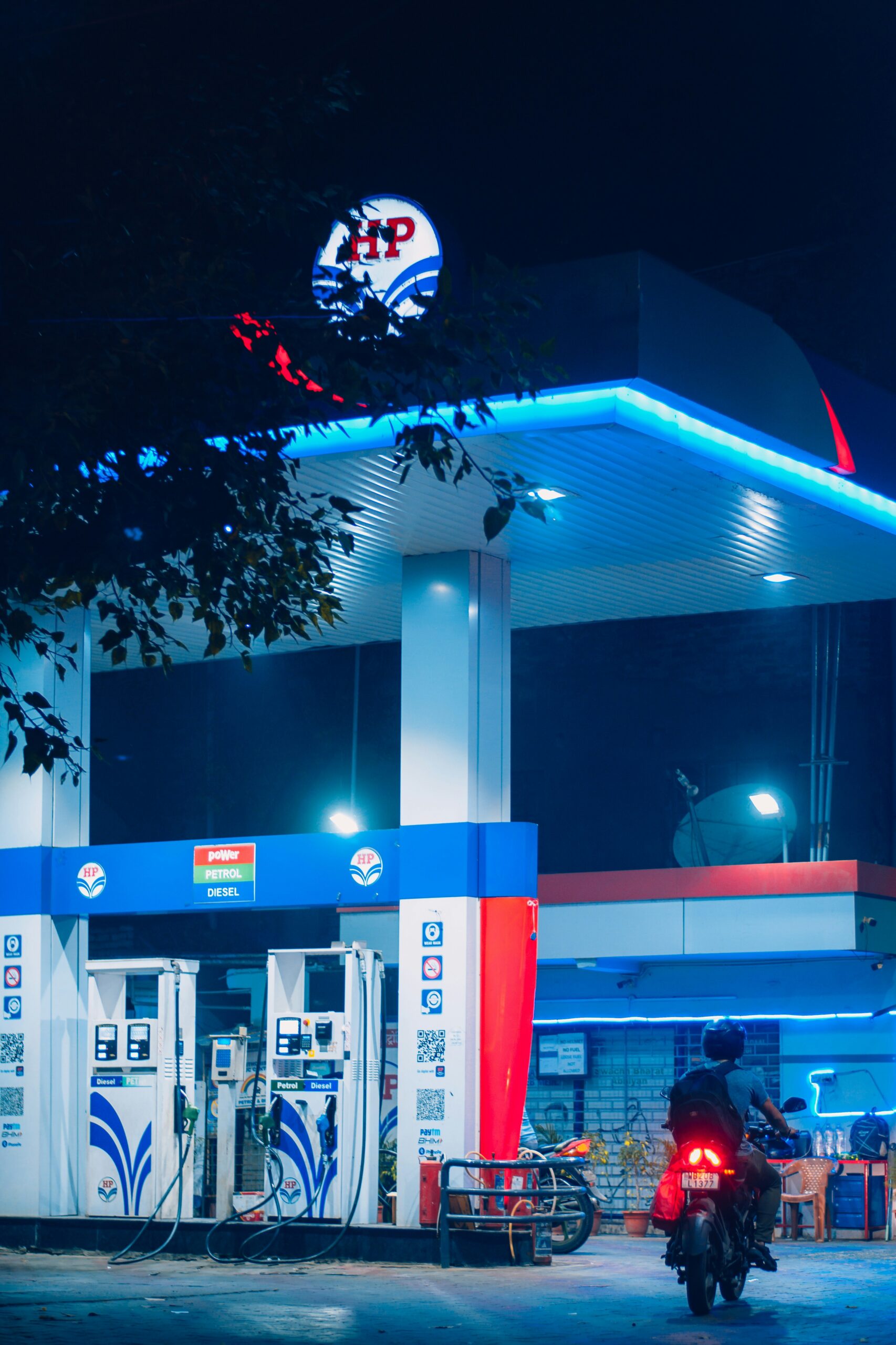
Illustrative image of a petrol station. Photo by Ramprasad Kansari via Unsplash.
Is petrol and diesel actually being brought under GST?
No—not yet.
Petrol, diesel and ATF are constitutionally capable of being brought under GST, but the GST Council has to recommend the date from which GST will apply. Section 9(2) of the Central GST Act similarly requires a GST Council recommendation before these petroleum products can be brought into the GST levy.
The latest development is a recommendation from an expert panel constituted by PNGRB. It does not itself change the tax paid at petrol pumps.
What exactly has the expert panel recommended?
The panel has recommended bringing petrol, diesel and ATF into the GST regime. It also recommended that, until that happens, the 2% Central Sales Tax (CST) currently applicable to inter-state sales of these non-GST petroleum products could be abolished or reduced to zero.
The committee’s reasoning is broader than simply cutting the retail price. It says the existing CST can distort the economics of moving fuel between states and can make it harder to shift transportation from road tankers to pipelines. Eliminating the CST could therefore improve logistics efficiency as well as simplify taxation.
Why are petrol and diesel outside GST in the first place?
When GST was introduced in 2017, petroleum products were kept outside the GST tax base largely because states wanted to retain their taxation powers and revenue from fuel.
Today, petrol and diesel are subject to a combination of central excise duties and state-level VAT or sales taxes. This means the tax structure can differ substantially from one state to another.
How much tax is charged on petrol and diesel in Telangana?
Telangana is an important example because its fuel VAT rates are among the highest in India. According to the Petroleum Planning & Analysis Cell (PPAC), Telangana currently levies 35.20% VAT on petrol and 27% on diesel.
That is one reason fuel prices in Hyderabad can be considerably higher than in some other cities. The final pump price also depends on the refinery/dealer price, freight, dealer commission and central duties.
So, would GST automatically make petrol cheaper?
No. GST by itself does not guarantee a particular retail price.
The eventual consumer price would depend on several decisions that have not yet been made: the GST rate, the taxable value on which GST would be calculated, what happens to central excise and other cesses, how existing state VAT revenue is replaced, and whether states receive a compensation mechanism.
This is why headlines suggesting that petrol will immediately become cheaper if it enters GST are premature.
What GST rate would make fuel cheaper?
There is no final GST rate for petrol or diesel because the products have not been brought into GST.
A commonly discussed scenario is a standard GST rate such as 28%, but that should be treated only as a hypothetical example—not as an announced fuel rate. Even a 28% GST rate cannot be directly compared with a state’s VAT percentage and used to calculate the final pump price because the two systems work differently and central excise, cess, dealer margins and the tax base also matter.
Why could GST still reduce fuel costs?
There are several possible channels through which a GST regime could reduce costs or improve efficiency.
- More uniform taxation: GST could replace a fragmented state-by-state tax structure with a common framework.
- Input tax credit: Businesses could potentially claim GST credits on eligible inputs, something that is not available in the same way under the current VAT/excise structure.
- Lower logistics friction: The PNGRB expert panel specifically highlighted the distortion created by the 2% CST on inter-state fuel movement.
- Pipeline economics: A more uniform tax regime could make it easier to move fuel between states through pipelines rather than relying as heavily on road transportation.
Could petrol actually become cheaper in Hyderabad?
It could, but nobody can responsibly put a final rupee figure on the reduction today.
Hyderabad is a useful case because Telangana’s 35.20% petrol VAT and 27% diesel VAT are high. If a future GST structure results in a substantially lower effective tax burden and the Centre and state governments do not replace the reduction with equivalent new levies, consumers could benefit.
But if the GST rate is high, or if additional cesses or other charges remain, the saving could be much smaller—or could disappear altogether.
What happens to the Centre and states’ revenue?
This is the biggest political and fiscal obstacle.
State governments depend heavily on fuel taxes because petrol and diesel currently sit outside GST. Bringing them into GST would change how that revenue is collected and shared. Any serious proposal therefore has to answer a difficult question: how will states replace or protect their fuel-tax revenue?
That is one reason this debate has repeatedly returned without producing a final GST decision on petrol and diesel.
Will the October 8 GST Council meeting decide fuel prices?
There is no confirmed indication that it will.
The 57th GST Council meeting has been rescheduled to October 8. Government officials cited by Hindustan Times said the meeting was unlikely to take a decision involving tax rates and was expected to focus on process reforms.
So the PNGRB recommendation should not be mistaken for an agenda decision to cut petrol or diesel prices at the October meeting.
What is the current price of petrol and diesel?
Prices vary by city and state because taxes and local charges differ. PPAC lists the Delhi retail selling price on October 1, 2026 at ₹102.12 per litre for petrol and ₹95.20 per litre for diesel. These are reference prices and should not be treated as Hyderabad prices.
What should motorists watch for next?
There are four developments that matter more than speculation about a particular rupee reduction:
- Whether the GST Council formally takes up petrol and diesel.
- What GST rate is proposed, if the products are brought under the regime.
- Whether central excise, road/infrastructure cess and other levies are retained, reduced or replaced.
- How states are compensated for the revenue they currently collect through VAT.
The bottom line: Will petrol and diesel become cheaper?
Maybe—but the headline is ahead of the policy.
The new development is an expert recommendation to bring petrol, diesel and ATF under GST. It is not a final government decision, and no GST rate for petrol or diesel has been announced.
If a future GST regime reduces the combined tax burden and removes some of the inefficiencies in today’s system, consumers could see lower prices. But if governments preserve revenue through a high GST rate, excise duties or additional cesses, the benefit at the pump could be limited.
For now, the safest answer to the question “Will petrol and diesel become cheaper under GST?” is: GST could make them cheaper, but it does not guarantee a price cut. The rate and the treatment of existing taxes will decide the outcome.
Sources and further reading
- Hindustan Times: Expert panel recommends bringing petrol, diesel and ATF under GST
- PPAC: State-wise VAT/Sales Tax/GST rates on petroleum products
- PPAC: Retail selling prices and October 2026 fuel-price data
- CBIC: Section 9(2) of the CGST Act
- GST Council: Petroleum products and GST background
- PIB: Constitutional and GST Council framework for petroleum products