 Gawah (The Witness) – Hyderabad India Fearless By Birth, Pristine by Choice – First National Urdu Weekly From South India – Latest News, Breaking News, Special Stories, Interviews, Islamic, World, India, National News

When Mir Barkat Ali Khan Mukarram Jah was coronated in April 1967, the royal ritual carried the gravity of centuries. The jewels, the titles, the lineage – all spoke of a highly illustrious era. Yet history had already moved on. Within four years, the abolition of privy purses would render the office of the world’s richest ruler symbolic, closing the chapter on one of India’s last princely houses.
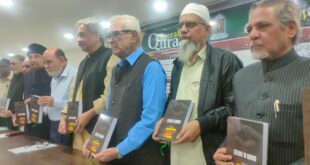
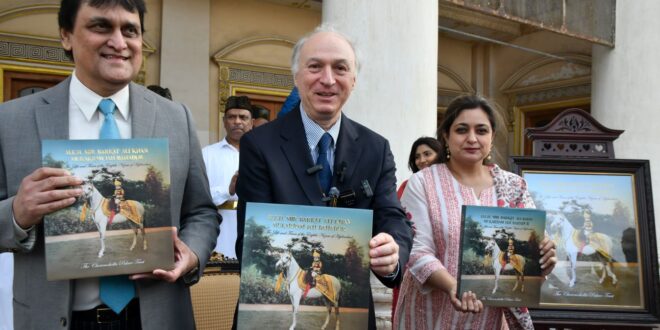
More than half a century later, a new limited-edition book and accompanying exhibition at Chowmahalla Palace attempt to bring back fragments of the royal world, lost to time and change, alive. Written by Anuradha S. Naik, an award-winning architect, designer, and author whose work focuses on architectural conservation and craft revival, particularly in the Deccan, the book is aptly titled “HEH Mir Barkat Ali Khan Mukarram Jah Bahadur – The life and times of Hyderabad’s eighth Nizam”.
Trained at the Edinburgh College of Art, the University of Edinburgh, and the Bartlett, University College London, the author has been closely associated with the restoration and curation of Chowmahalla Palace since 2010.
Featuring over 250 rare and previously unseen photographs, many drawn from private family collections, the book revisits the life of a man who inherited a crown just as it ceased to matter. The images, formal portraits, intimate moments, travel photographs, letters of correspondence, trace a life lived across continents amid collapsing empires, revealing a figure shaped as much by history’s withdrawal as by its inheritance.
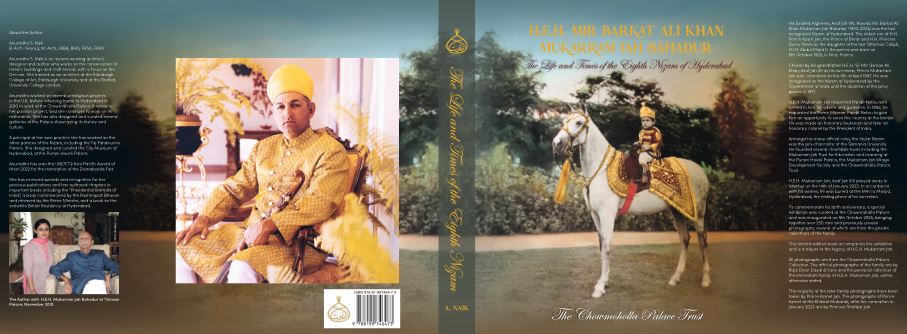
Born in 1933 in Nice, France, Mukarram Jah entered the world already at the intersection of multiple legacies. He was the grandson of Mir Osman Ali Khan, one of the world’s richest men in his time, and the great-grandson of the last Ottoman Caliph Abdul Mejid II, through his mother, Princess Durru Shehvar. His childhood unfolded largely outside Hyderabad, but it inherently defined his relationship with Hyderabad and its people.
Chosen by his grandfather as successor, Mukarram Jah ascended the throne at a moment when India was redefining sovereignty itself. He sought counsel from Jawaharlal Nehru, and in 1962, during the Sino-Indian conflict, he asked for the opportunity to serve the country at the border, an unusual gesture for a ruler whose authority was already ceremonial. There are photographs of the letters that testify to his patriotic urge. He was later appointed an honorary lieutenant and then an honorary colonel by the President of India.
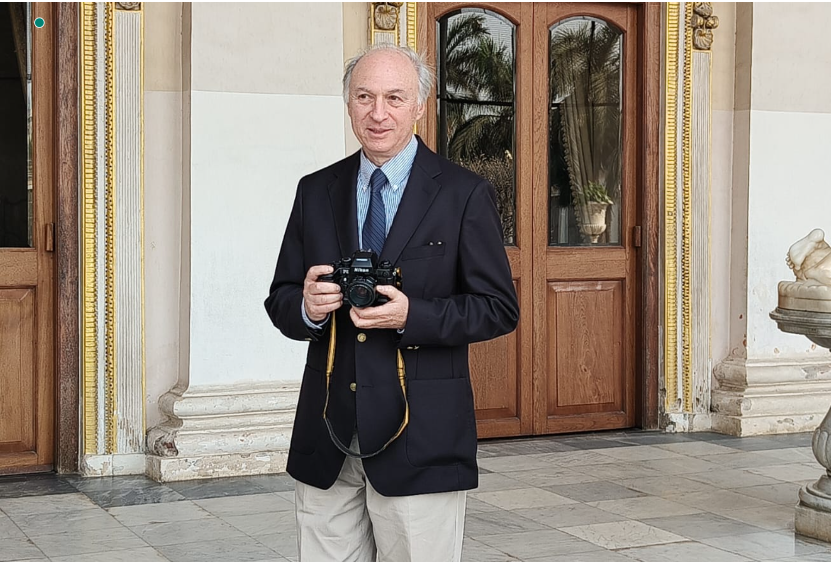
Several of the later family photographs featured in the book were taken by Nawab Azmet Jah, a trained cinematographer, and the present head of the Asaf Jahi family.
The photographs in the book reflect a stark contrast, depicting not just formal courtly life, but also of a man at ease in quieter settings, away from spectacle. What emerges is not the familiar portrait of royalty, but bespoke multi-dimensional personas.
After the abolition of privy purses in 1971, Mukarram Jah withdrew from public life. His later years were spent largely abroad, far from the city whose name he carried. And yet, Hyderabad remained central to his sense of belonging. Publicly reticent, he appeared to grasp, perhaps sooner than many, that in the Republic of India, the legacy of former royalty would endure in education more than authority.
He donated Purani Haveli, an ensemble of eight palaces, and established an eponymous trust to further educational initiatives, offering future generations the opportunity to shape their own histories. According to Nawab Faiz Khan, Trustee of the Mukarram Jah Trust for Education and Learning, the Mukarram Jah School, managed by the trust, has continued to fulfil, and in many ways exceed, its founding mandate, consistently being ranked among India’s leading budget schools.
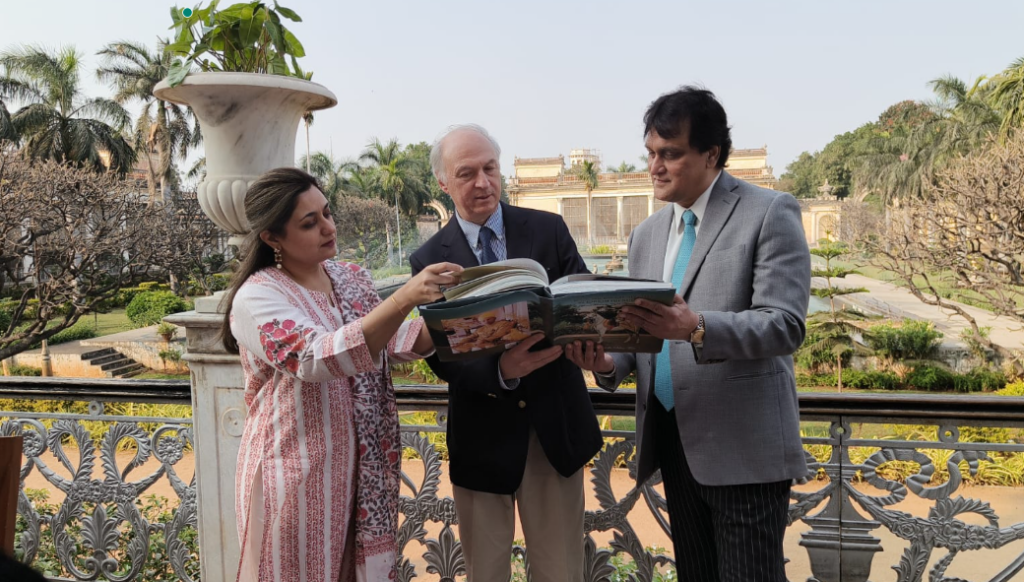
Nawab Azmet Jah, his son and heir to the Nizam family, has on several occasions reiterated that the eighth Nizam regarded education as central to his public purpose.
Perhaps, in doing so, Mukarram Jah seemed to accept that the Nizams of Hyderabad were no longer called upon to command history. They had become part of it, woven into the city’s past in ways that, even amid Hyderabad’s rapid modernisation, remain inseparable.
When he passed away in Istanbul in January 2023, his final wish was to be buried at the historic Makkah Masjid of Hyderabad, alongside generations of his ancestors. In death, he returned fully to the city, forever.
The book, brought out by the Chowmahalla Palace Trust, resists the temptation to romanticise. Instead, it functions as a visual archive, situating Mukarram Jah within the broader story of his life, previously privy to a handful few. The accompanying exhibition, curated to mark his birth anniversary, allows visitors to reflect on his life through these images.
There is a contemporary resonance to this effort. Across the world, societies are re-examining inherited privilege, monuments, and the meaning of legacy. In that context, Mukarram Jah’s life offers a rare case study – a ruler who neither clung to authority nor sought to dramatise its loss.
What the photographs ultimately preserve is not a reign, but a sensibility – a way of inhabiting an inherited role without illusion. In an age when history often survives as headline or hashtag, this book, and the exhibition, are a rare deviation.
The book does not seek to explain itself aloud. Nor does the exhibition design, executed by a firm led by the same author. The photographs are left to speak for themselves, each picture, as cliche as it may sound, is worth more than a thousand words of history.
In those frames, Hyderabad’s last Nizam is neither ruler nor exile. He is simply present, in a dozen different personas, that quietly silences naysayers, and critics, and in a form that history cannot abolish.