 Gawah (The Witness) – Hyderabad India Fearless By Birth, Pristine by Choice – First National Urdu Weekly From South India – Latest News, Breaking News, Special Stories, Interviews, Islamic, World, India, National News

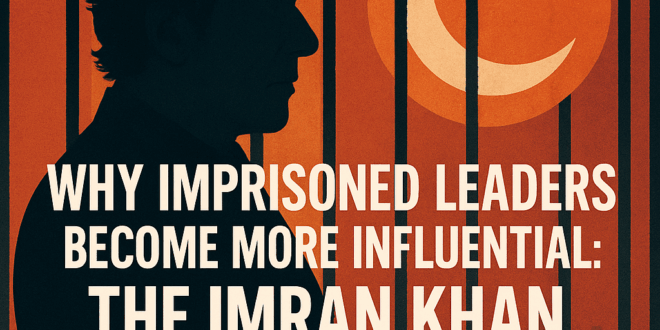
Across history, something strange and significant happens when a political leader is jailed. Their physical presence disappears, yet their influence grows. Their voice is restricted, yet their message spreads further. Their visibility is reduced, yet their image becomes larger than life. This paradox is resurfacing today with Imran Khan, Pakistan’s former prime minister, whose imprisonment has created a political, psychological, and cultural ripple far beyond the walls of Adiala Jail. Whether one supports him or not, it is undeniable that his captivity has transformed him from a political figure into a symbol, and symbols are much harder to silence.
This phenomenon is not unique to Pakistan. It has appeared again and again in the lives of leaders across continents. The question is simple: why do imprisoned leaders become stronger, not weaker?
The moment a leader is jailed, the myth begins. A political opponent may be debated, criticized, or dismissed. A jailed figure becomes a story. Politicians can be questioned, but stories cannot. Imran Khan is no longer just the chairman of a party or a former prime minister; to many, he is the central character in a national struggle, a protagonist in a narrative of resistance and injustice. This same transformation elevated Nelson Mandela from activist to global icon, Aung San Suu Kyi from politician to symbol of democracy, Mahatma Gandhi from freedom fighter to moral leader, and Sheikh Mujibur Rahman into the face of Bengali liberation. When a leader is imprisoned, supporters do not see weakness. They see persecution, and persecution is one of the fastest paths to myth-making.
There is also the psychology of martyrdom. Human societies instinctively rally behind suffering. A leader behind bars triggers the belief that if someone is being punished so heavily, they must represent something powerful. Silencing produces sympathy. Restrictions produce resistance. Isolation produces imagination. The less Pakistanis see of Imran Khan, the more they talk about him, speculate about him, idealize him, and project their frustrations onto him. His absence becomes a space that people fill with their own hopes and anger. A jailed leader becomes a canvas.
Censorship adds another layer. The tighter the restrictions, the stronger the public curiosity becomes. If a photo is withheld, society imagines a thousand versions of it. If appearances are limited, speculation grows uncontrollably. If access is restricted, people assume the worst. This is happening now with Imran Khan as mysteries around his health and isolation fuel enormous public interest. Censorship becomes gasoline, rumour becomes the match, and the public conscience becomes the fire.
Then comes the diaspora effect. Millions of Pakistanis abroad in the UK, Middle East, Europe, Canada, and the US follow these developments with more intensity than those inside the country. For them, Imran Khan is not just a politician but a symbol of the Pakistan they hope for. Diaspora communities tend to emotionally amplify national issues, and digital platforms multiply that amplification. Every update, rumour, or court appearance becomes global news within minutes.
Modern social media plays a decisive role as well. Platforms like X, TikTok, YouTube, and Instagram reward conflict, emotion, injustice narratives, and symbolic heroes. A political prisoner today does not disappear; they trend. The less visible Imran Khan is, the more the internet debates him, recreates him through AI images, analyzes his words, and searches for meaning behind even the smallest piece of news. Digital platforms thrive on mystery and suffering, and Imran Khan’s story fits perfectly into that algorithmic hunger.
At a deeper level, people rally not behind individuals but behind what individuals represent. When free, a leader’s flaws, errors, and contradictions are visible. When jailed, they become pure symbolism. Imran Khan, in prison, speaks different things to different groups: hope, justice, resistance, nationalism, accountability, or moral defiance. In jail, he no longer defines his message; the public defines it for him. People speak for him, project onto him, and amplify him. That is the ultimate form of influence.
History shows the same pattern. Jail does not break leaders. Jail builds legends. Mandela, Gandhi, Mujib, Lula da Silva, Nehru, Bhutto – many of the most influential political figures of the last century experienced a rise in moral authority and public support not during their time in office, but during their imprisonment. Imran Khan now fits within this historical arc, whether one agrees with his politics or not. The longer he stays behind bars, the more he shifts from politician to political force, from leader to symbol, from man to myth.
In the end, power does not always come from authority. Sometimes it comes from absence. Jail isolates the body but amplifies the idea. Walls restrict one person, but they cannot contain a movement. When a leader is imprisoned, they no longer participate in politics; they become the politics. That is the Imran Khan effect, a transformation created not by victory but by adversity, not by power but by resistance, and not by speeches but by silence.
Disclaimer:
The views expressed here are analytical in nature and do not represent political advocacy. This article does not support or criticise any government, political party, or judicial process. It discusses widely documented global patterns and should not be interpreted as commentary on any current political dispute.