 Gawah (The Witness) – Hyderabad India Fearless By Birth, Pristine by Choice – First National Urdu Weekly From South India – Latest News, Breaking News, Special Stories, Interviews, Islamic, World, India, National News

Judiciary Is the Guardian of Human Rights, Say Legal Luminaries at National Seminar
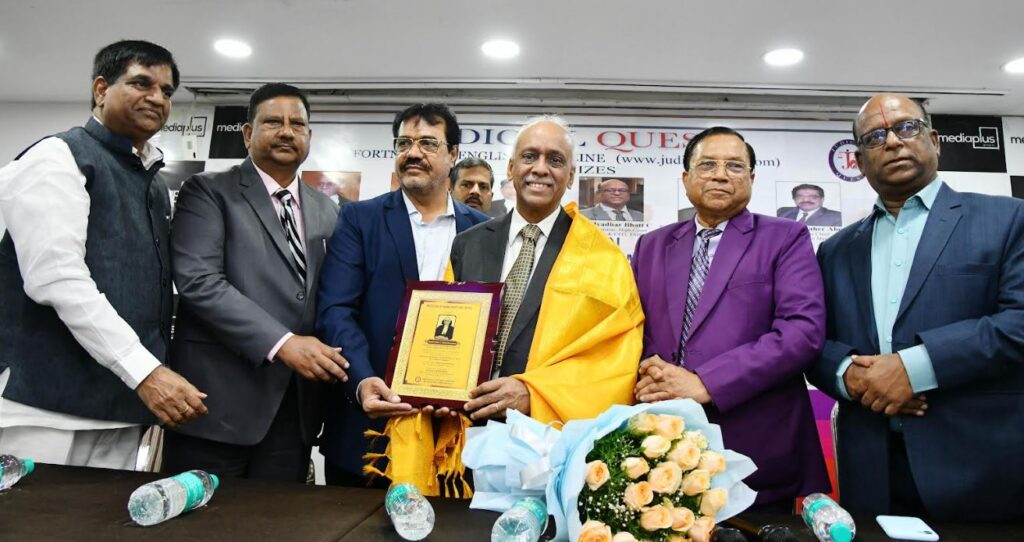
Hyderabad, June 17, 2025 – “Free speech does not mean hurting the sentiments of others,” remarked Justice V. Ramasubramanian, Chairperson of the National Human Rights Commission (NHRC) and former judge of the Supreme Court of India, while addressing a national seminar on “Judiciary as the Guardian of Human Rights: An In – Depth Evaluation” held at Media Plus Auditorium on Tuesday evening. The event was organized by Judicial Quest, a fortnightly legal magazine.
Justice Ramasubramanian emphasized the delicate balance courts must maintain when constitutional freedoms come into conflict. “When two rights compete, the courts must apply extreme caution. In such cases, Article 18 helps determine which right prevails,” he noted.
India is not an easy country to govern, he said, highlighting the judiciary’s role since Independence and classifying its contributions into four key areas. The first, he said, is facilitating access to justice. “Facilitating access to justice for the common man is the first step,” he said. In a country of over 1.4 billion people, with eight major religions, 22 official languages, 2,600 dialects, and over 3,600 castes and communities, access remains both a challenge and a priority.
Expanding the Scope of Article 21: Article 21, which guarantees the right to life and liberty, has evolved to include the right to livelihood, dignity, and freedom of movement. “Today, we don’t just see life as the opposite of death. It has expanded to include the right to livelihood, the right to travel, and the right to dignity – including the right to die with dignity,” he said.
The third important contribution, he noted, is uplifting Directive Principles. He explained that the judiciary has interpreted the Directive Principles of State Policy as enforceable by aligning them with Article 21, thereby giving them constitutional strength.
The fourth core contribution, he said, is creating laws where none exist. He praised the courts’ proactive role in establishing temporary legal frameworks – such as gender sensitization committees for women – in the absence of formal legislation. He referred to how Parliament later enabled these committees to ensure a safe workplace for women.
Justice Dr. Shameem Akhtar, Judge of the Telangana High Court, remarked, “No system is perfect, but ours is evolving towards a more just and compassionate society.” He firmly dismissed the notions of judicial activism and judicial overreach, stating that “both the High Courts and the Supreme Court are functioning strictly within the framework of the Constitution.”
Dr. Vidyadhar Bhatt C., Secretary and CEO of the Telangana State Human Rights Commission (TSHRC), stated that in a democratic country, the judiciary is the guardian of human rights. He acknowledged the judiciary’s intent to deliver justice swiftly but noted that systemic hurdles often hinder its pace. He also remarked that prisons are increasingly becoming centers for rehabilitation, and he appealed to citizens to support and uphold the judiciary in its mission for justice.
Dr. Adish C. Aggarwala, President of the International Council of Jurists and former President of the Supreme Court Bar Association, lauded the judiciary’s unwavering commitment during national crises. “Even during the COVID – 19 lockdown, when most institutions were shut, the courts remained functional, safeguarding public interest and fundamental rights,” he said. He emphasized that the government and judiciary must work in harmony to advance the cause of justice.
Senior Telangana High Court Advocate C. Damodar Reddy stressed the need for judicial reforms, including increasing the number of judges and adopting technology more widely to improve judicial efficiency. “The justice delivery system must be made inclusive so that even the marginalized have equal access,” he said. He added that the judiciary’s future depends on its ability to withstand internal challenges and external pressures while remaining committed to the values of equality and fairness.
Organizer and Editor Judicial Quest Fortnightly Syed Taher Ali Abedi expressed hope that the national seminar will act as a beacon of hope especially in challenging times where the last few weeks have coerced people to question the status of human rights and judicial system in India, especially after the controversial arrest of Ashoka University Professor Ali Khan Mahmudabad.
The seminar concluded with a consensus that the judiciary remains the most trusted and consistent guardian of human rights in India. The event was attended by senior members of the bar, law students, civil society representatives, and members of the media.
Earlier, event Master of Ceremony Ms Nyathakaala Sahasra Chandana and program coordinator Syed Azmath Hussain Jaffery were felicitated by Judicial Quest. Media Plus CEO Syed Khaled Shahbaaz presented a vote of thanks.