Anniversary special | October 2026
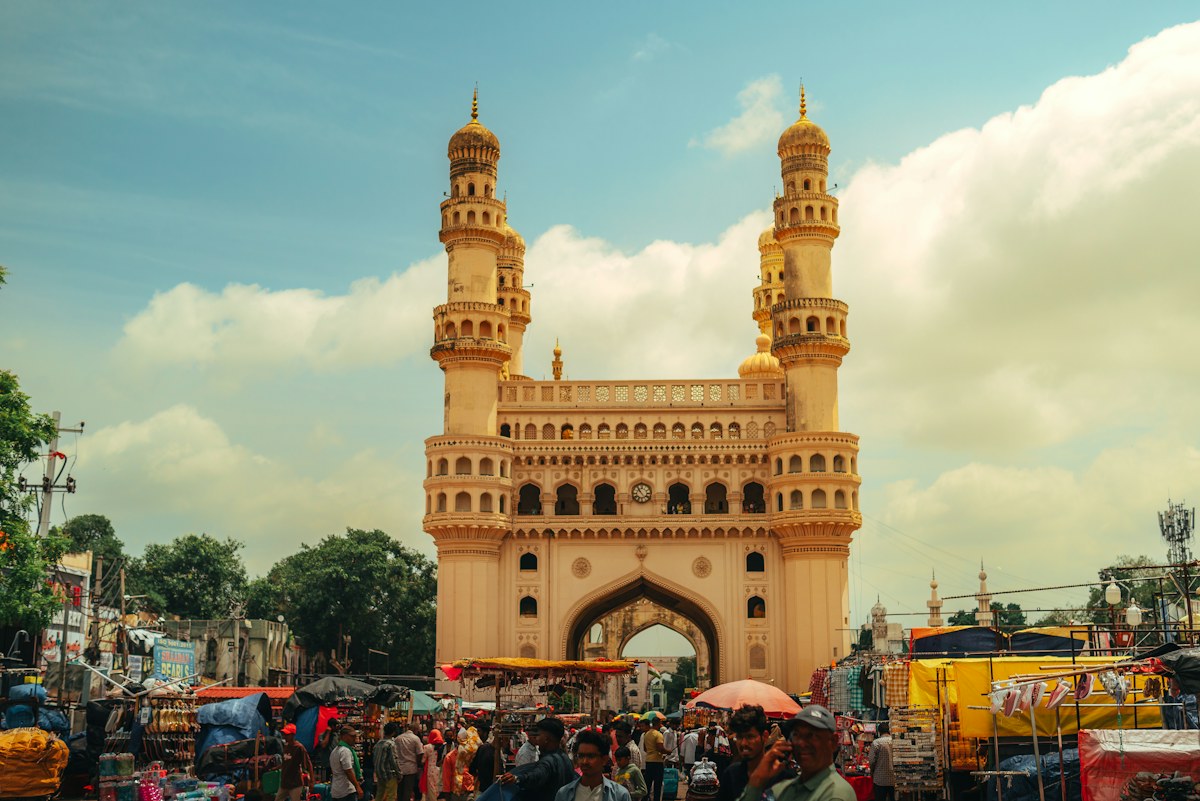
In Hyderabad, directions often begin with a familiar landmark: “Charminar ke paas” — near Charminar. The phrase works across generations and across the city’s busy streets. It tells a visitor where to go, helps a shopper locate a market and places an address within a shared mental map of Hyderabad.
It is an everyday reminder of the extraordinary role played by a building conceived more than four centuries ago. Charminar is not simply a monument that survived the city’s growth. It was part of the vision through which Hyderabad began.
A new capital beyond Golconda
In the late sixteenth century, the Qutb Shahi rulers governed from Golconda, a fortified centre linked to regional power and trade. During the reign of Sultan Muhammad Quli Qutb Shah, a new city was established beyond the old capital. Hyderabad’s foundation is traditionally dated to 1591, and Charminar was conceived as the focal point of that new urban settlement.
The distinction matters. Charminar was not an ornamental addition to a city that had already taken shape. It occupied a central place in the plan of the new capital. The monument’s four gateways opened towards the principal directions, and the streets extending from the area helped organise the settlement around a recognisable centre.
The UNESCO World Heritage Centre’s tentative-list documentation describes Charminar as the symbolic fulcrum of historic Hyderabad’s layout. The monument and the city were conceived together: one gave the other a physical centre and a lasting point of reference.
Why was Charminar built?
Charminar’s origins have gathered several accounts over the centuries. The best-known tradition links its construction to the end of a devastating plague. In this telling, Muhammad Quli Qutb Shah had prayed for relief and commissioned the monument in gratitude when the crisis passed.
Another interpretation connects the building to the beginning of the second Islamic millennium, corresponding to 1000 Hijri. The monument has also been discussed in relation to the religious and political symbolism of the Qutb Shahi court.
These accounts are part of Charminar’s historical memory, but they should not be presented as though every detail is conclusively established. The precise original purpose remains a matter of historical interpretation. What is clearer is that Charminar was built at the foundation of Hyderabad and became closely associated with the new city’s prosperity and identity.
The monument’s foundation inscription is commonly translated as a prayer asking God to fill the city with people as a river is filled with fish. Whether encountered as an inscription or through its translation, the sentiment is striking: the building was associated with the hope that the new city would flourish.
Nine lakh rupees for a city’s centrepiece
Historical accounts commonly place Charminar’s construction between 1589 and 1591 and report a cost of nine lakh rupees. A technical-details panel accompanying Mohammed Safiullah’s article, “Save the dying minars,” published in The Hindu MetroPlus on August 2, 2001, also lists the construction cost as Rs 9 lakh. The clipping does not present this figure as a direct quotation from Safiullah, so we attribute it to the published panel rather than putting it in his words. The figure is a reminder of the resources committed to the project, although period costs should not be compared directly with modern rupee values without reliable historical economic evidence.
Built with materials including granite and lime mortar and enriched with elaborate stucco work, Charminar was designed to be seen and used. Its four large arches created openings through the structure, while the minarets gave the building a distinctive profile above the streets. A mosque occupies the upper level, placing religious life within the monument that became the city’s most recognisable landmark.
Its architecture belongs to the Deccan of the Qutb Shahi period, shaped by Persianate influences and the artistic traditions of the Indian subcontinent. Reducing it to a single influence would miss the cultural exchange visible in its design.
A monument that helped orient a city
Look out from Charminar today and the traffic, shopfronts and dense urban fabric can make the original plan difficult to imagine. Yet the monument’s position remains legible in the historic city. Streets, gateways, markets and public spaces developed in relation to this central point.
The surrounding area grew into a place of commerce as well as civic and religious life. Char Kaman and Gulzar Houz form part of the historic setting, while the nearby Mecca Masjid adds another major layer to the area’s architectural and religious history. Laad Bazaar, known for its bangles and bridal shopping, continues the commercial life of the Old City.
These places should not be treated as a collection of unrelated attractions. Together, they form a living urban landscape in which architecture, trade, worship and everyday movement overlap. The monument’s meaning is inseparable from the streets and communities around it.
From the Qutb Shahi capital to modern Hyderabad
Hyderabad has changed dramatically since 1591. It has passed through successive political eras and expanded into a metropolis associated today with technology, pharmaceuticals, research, business and international connections. The city now stretches far beyond the historic settlement imagined by its founders.
Yet Charminar remains a reference point. It appears in the way people describe locations, in the mental map residents carry of the Old City and in the image through which Hyderabad is introduced to visitors. That continuing relevance does not mean the city has stood still. It means the monument has acquired new meanings as the city around it changed.
For some, Charminar is an architectural landmark; for others, it is a place of prayer, shopping, work or family memory. For historians, it is a surviving document of the Qutb Shahi period. For visitors, it is often the first encounter with Hyderabad’s older urban world.
No single building can contain the full history of a city. But some buildings become the place where that history is most readily recognised. Charminar is one of them.
435 years on
The anniversary traditionally associated with Charminar’s completion in 1591 offers an opportunity to look beyond the familiar silhouette. The monument tells us about the founding of a capital, the ambitions of its rulers, the artistic traditions of the Deccan and the importance of planning a city around a shared centre.
Its survival also places a responsibility on the present. Conserving Charminar means protecting not only its masonry and ornament, but also the historic setting that gives it meaning. The streets around it remain busy, lived-in and commercially important. Their future must be considered alongside the monument itself.
Four hundred and thirty-five years after Hyderabad’s founding, the city is far larger than its original plan. But at the heart of the historic centre, the four minarets still tell a story about how Hyderabad began—and why that beginning continues to matter.
Sources and further reading
- UNESCO World Heritage Centre: Qutb Shahi Monuments of Hyderabad (tentative-list documentation)
- Hyderabad District Administration
- Telangana Tourism
Part 1 of GAWAH News Desk’s “Charminar at 435” series.