 Gawah (The Witness) – Hyderabad India Fearless By Birth, Pristine by Choice – First National Urdu Weekly From South India – Latest News, Breaking News, Special Stories, Interviews, Islamic, World, India, National News

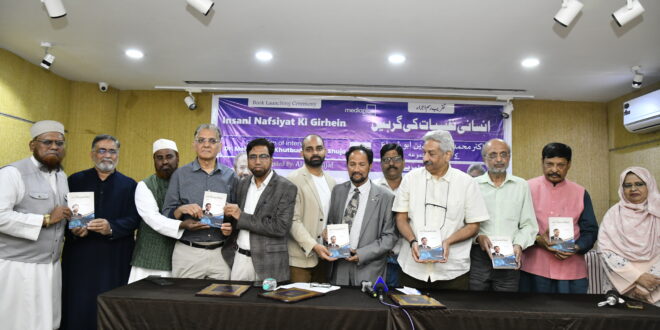
Insani Nafsiyat Ki Girhein Released in Hyderabad
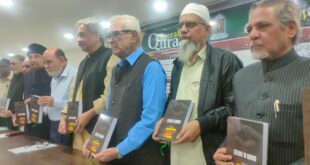
Hyderabad, February 17: A compelling call to restore faith, introspection, and human connection in an increasingly digital world marked the release of Insani Nafsiyaat Ki Girehen (The Knots of Human Psychology), a compilation of interviews with Indian-American psychiatrist Dr. Mohammed Khutbuddin, authored in Urdu by UK-based psychiatrist Dr. Alizeh Najaf.
The book was released at a well-attended function at the Media Plus Auditorium, Gun Foundry, organised by Media Plus Foundation. The gathering brought together doctors, academics, media professionals, and members of civil society for a reflective discussion on the psychological challenges confronting contemporary society.
Delivering the keynote address, Dr. Khutbuddin observed that the growing incidence of psychiatric disorders is closely linked to modern lifestyles shaped by artificial intelligence, social media, and consumer culture. “We have gradually offloaded our thinking and introspection to machines,” he said, cautioning that excessive dependence on AI risks stagnating the human intellect and weakening emotional resilience.
He noted that the curated glamour of social media – influencers, reels, and celebrity lifestyles – has fostered unhealthy comparison and imitation, fuelling forced consumerism and eroding authentic relationships. “It is not enough to appear prosperous; one must cultivate richness of heart, inner peace, and sincerity,” he remarked.
According to him, the absence of love, empathy, and meaningful human connection lies at the heart of many psychological disorders. He urged individuals to reconnect with their own souls, avoid dissipating emotional energy on trivial pursuits, and maintain balance through moderation in lifestyle. Referring to ancient Islamic teachings on mindfulness, he said that spiritual growth requires simplicity of heart and calmness of mind.
Quoting poet-philosopher Allama Iqbal – “Tum agar mera banda na ban, apna to ban” – he underscored the importance of self-realisation and authenticity. He described psychiatrists as “agents of hope and courage who treat invisible illnesses” affecting people across age groups.
Former Director General of Police Syed Anwar-ul-Huda said that true peace lies in the remembrance of God and advised turning to voluntary prayer during times of distress. Reflecting on rising mental health concerns in materially advanced societies, he observed that emotional isolation persists despite comfort and affluence. “In the age of social media, one may have thousands of followers, yet no one to truly listen,” he said.
Recalling the COVID-19 pandemic, he described it as a period when fear and distancing deepened emotional fractures within families and communities. He emphasised that despair must be countered with faith and resilience, adding that compassion towards those who have lost loved ones can serve as a powerful antidote to psychological stress.
Former Doordarshan Director Dr. Shujath Ali Sufi termed loneliness “the biggest disease of our times” and identified it as a root cause of depression. Early psychiatric consultation, he said, could save not only an individual’s life but also protect the well-being of family members.
Activist and scholar Dr. Rafia Nousheen presented a scholarly paper on Dr. Khutbuddin’s contributions, describing the book as an intellectual trust that addresses the pressing mental health needs of society. She noted that a significant proportion of individuals in India experience mental stress and require encouragement and structured support.
Compering the event, Dr. Fazil Hussain Parvez, Editor of Gawah, interwove reflections and commentary that sustained audience engagement throughout the nearly three-hour programme. Media Plus CEO Syed Khaled Shahbaaz welcomed the gathering and delivered the vote of thanks.
Speakers collectively emphasised that many physical ailments have psychological origins and that simple acts of kindness, acknowledgment, and empathy within families and workplaces can prevent emotional distress.
The overarching message of the evening was clear: in an era shaped by artificial intelligence, digital distraction and social fragmentation, sustainable mental health depends not merely on clinical intervention but on faith, compassion, self-awareness, and the restoration of genuine human bonds.
Dr. Tabrez Hussain Taj, Dr. Sikandar Ali Khan Lodhi, Dr. Mahmood Siddiqui (Dean, Maulana Azad National Urdu University), Mirza Abdul Qayyum Nadvi, Maulana Syed Rifaat Ali Naqshbandi Qadri, Mushtaq Malik, K.N. Wasif, J.S. Iftikhar, Dr. Anis Manzoor Ahmed, Syed Iftikhar Hashmi, Syed Zahooruddin (Chairman, Secunderabad Cooperative Bank), Mohammad Husamuddin Riyaz, Mohammad Abdul Rashid (Jamaat-e-Islami), Dr. Azhar Ansari, Dr. Nazim Ali, Mujahid Siddiqui, Sheikh Kaleem Al-Omudi, Mohammad Farooq Ali, were among other distinguished guests.