The All India Milli Council marked its 33rd Formation Day with a call for greater involvement of Muslim youth, intellectuals and civil society in safeguarding constitutional rights, countering hate-driven propaganda and working towards a peaceful, plural society.
The gathering emphasised the need to move beyond expressions of concern towards organised, peaceful and constitutional action to address the challenges confronting the community.
Recalling the circumstances that led to the council’s formation, speakers referred to the communal tensions surrounding the demolition of the Babri Masjid on December 6, 1992. Religious scholars, clerics and community leaders recognised the need for an organised platform to address the concerns of Muslims and strengthen their collective voice.
The initiative took shape in Mysore, where a committee laid the foundation for the council in the presence of a large gathering of Islamic scholars and clerics at Masjid Tipu Sultan Shaheed. The life and legacy of Tipu Sultan served as an inspiration for the initiative.
Addressing the gathering, Janab Zafar Masood, Acting President of the All India Milli Council, said the organisation’s relevance must ultimately be measured by its achievements rather than its declarations. Its work, he said, should translate into tangible outcomes, including resolving problems faced by the community and securing justice for Muslims who have been wrongly implicated in cases.
Mufti Mohammed Omer Abideen, General Secretary of the council, called for greater involvement of young people and intellectuals in defending the rights guaranteed by the Constitution.
Drawing a parallel with India’s freedom struggle, he said that just as people had mobilised to secure the country’s independence, citizens must now work collectively to protect their constitutional rights through lawful and democratic means.
Referring to constitutional guarantees relating to education, freedom and freedom of expression, he said these rights required active engagement rather than passive concern.
He said the gathering sought to mobilise intellectual support to address Islamophobia, hate crimes and divisive trends, and to counter negative propaganda circulated by certain entities through informed engagement and constructive public discourse.
The objective, he said, should be to build a peaceful and tolerant society in which people of all religions coexist, upholding India’s tradition of communal harmony.
Speaking on the purpose of human life, Mufti Omer Abideen said angels had been given goals and objectives but not desires, while animals had desires but no defined goals beyond survival. Human beings, he said, had been endowed with both.
“If human beings abandon their goals and objectives, they are no better than animals,” he observed.
Expressing concern over the growing tendency to equate success with prestigious employment, material comforts and luxurious lifestyles, he said professional accomplishments and intellectual pursuits must go hand in hand with social responsibility.
Luxury, he cautioned, could become a distraction and a shackle that prevented people from fulfilling their larger responsibilities.
He urged Muslims not to wait for ideal circumstances or the best time to begin working for society, but to remain committed to their responsibilities until their last breath. As followers of Prophet Muhammad (peace be upon him), Muslims should use every moment wisely in the service of their families, society and the wider community, he said.
Senior advocate Afsar Jahan, who is associated with the council’s legal team, called upon non-governmental organisations to work in unison towards strengthening and uplifting the community.
She referred to the council’s diverse departments, including those dealing with modern education, humanitarian assistance, policy advocacy, media, political affairs and human development, and said coordinated work across these areas could help address a wide range of community concerns.
Momin Roshan Zameer, also associated with the council’s legal team, was among those present.
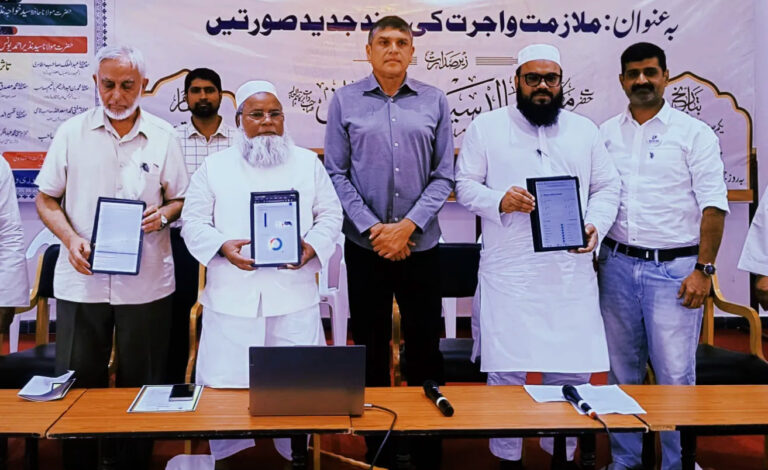
The gathering also witnessed the presentation of the All India Milli Council’s constitution, prepared with contributions from legal experts and intellectuals from the Muslim community.
Those present included Mufti Mohammed Omer Abideen, General Secretary; Janab Zafar Masood, Acting President; Advocates Afsar Jahan and Momin Roshan Zameer, members of the council’s legal team; Dr. Nayyar Farozan, Secretary-Correspondent of Azaan International School; and Syed Khaled Shahbaaz.